
“The Pitt,” is having a very large moment. The juggernaut series on HBO Max has been winning almost universal acclaim, bringing home Golden Globe Awards for “Best Television Series - Drama” and “Best Performance by a Male Actor in a Television Series – Drama” for star Noah Wyle.
HBO Max’s celebrated medical drama tells the story of a single 15-hour shift in a Pittsburgh emergency room, one frantic and overwhelming hour at a time. This unique narrative style is paired with fast-paced action, a gritty tone, and relatable characters, led by Wyle’s Dr. Michael 'Robby' Robinavitch.
The Pitt has garnered praise from the medical community for its realistic portrayal of care in an emergency trauma center. That’s in no small part thanks to having board-certified emergency doctors involved both with the writing process and as on-set advisors.
This attention to detail and accuracy is, to put it kindly, not always a priority in the world of television. Over-the-top dramatic moments often win out over following medical protocol, and sensationalism keeps viewers watching far longer than safety checklists.
So, with season two almost finished while maintaining those high standards, it’s reassuring to know that we CAN have it both ways.
To better appreciate how rare that is, we thought we’d explore a few examples of television moments that came up a little short on medical accuracy. These shows no doubt had their reasons: keeping the plot moving, a great focus on outcomes over how to get there, or, in some cases, an almost pathologic aversion to reality. And sometimes, a show is just, you know… pretty bad?
So, in celebration of The Pitt, we offer a few counterexamples. (The Pitt vs. the pits? Pitfalls?) After all, sometimes the best way to learn is to watch someone do things wrong. (Sometimes, horribly, horribly wrong.)
Let’s start with a classic medical misrepresentation, one so pervasive that it genuinely shocks people to learn it. And yes, pun intended. (Full disclosure: settle in, folks. There will be more of these.)
Show: Grey’s Anatomy
-
Episode: Out Of Nowhere (Season 14, Episode 8)
-
Questionable Medical Care: Shocking A Flatline
It’s not the hottest of takes to suggest that Grey’s Anatomy, the long-running medical drama/soap opera, tends to be a little light on realism. Set in a Seattle teaching hospital, the show plays fast and loose with almost every aspect of a hospital emergency room: the role surgeons play, the scope of the regular disasters faced, and the number of HR violations that can be tolerated before the entire staff is let go.
But setting aside the torrid romances, interpersonal drama, and occasional live bazooka shell lodged inside a patient (yes, that did happen) the show is a great example of how intense and frantic moments can make for compelling television. (Yes, the show has its haters, but come on… It’s in its 22ND SEASON. It’s doing SOMETHING right… even if it’s not always the medicine part.)
And while Grey’s Anatomy is by no means the only example of our first violation (not by a long shot), it is a good poster child for WHY this misrepresentation continues to show up in film and television.
The Scenario:
When a hacker remotely takes control of all of the hospital’s systems, multiple heart monitors, or electrocardiograms (ECG or EKG), start sounding alarms and show a “flatline,” indicating that a patient’s heart has stopped beating. (The EKG measures electrical activity, showing spikes during beats. A heart that isn’t beating, also known as asystole, has no electrical activity, so the EKG remains a flat line. Hence, “flatline” or “flatlining.”)
To restart this tidal wave of flatlined hearts, the doctors rush to their patients with crash carts to use a defibrillator, a device with a set of paddles or pads that are placed on the patient’s chest. As is the norm for this medical trope, they dramatically yell “CLEAR!”, warning everyone to get out of the way, lest some medical team member catch some stray voltage. (This is a real concern, btw.)
Typically, after a few failed attempts that serve to heighten the drama, the heart finally restarts, and the patient wakes up, often to a full recovery.
In this case, most of the team notices that the patients aren’t actually experiencing any cardiac distress; it’s a collective false alarm. The only unlucky patient to get shocked was zapped out of a nap. And no, he wasn’t happy about it.
Except… that’s not how a defibrillator is used. In addition to being a very fun word to say, a defibrillator is used to restore a heart’s normal rhythm. Erratic heart rhythms (arrhythmias) can be life-threatening, and a defibrillator can get things back to normal. And while it does shock the heart, a defibrillator functions as more of a reset. And most importantly, it needs the heart to be beating in order to work.
In fact, modern defibrillators will only provide a shock if they detect a shockable rhythm. So this event happening in the real world is highly unlikely.
Then why do this? Why perpetuate this misunderstanding? One word: drama. People like seeing cause and effect: a bold stroke of action that saves the day. Accuracy often takes a back seat, even if it keeps a myth alive that can cause confusion in an emergency situation.
While we’re calling out overly dramatic story elements, many examples of this scenario in television depict the patient immediately regaining consciousness, alert and ready to go home. So it’s worth noting that while it is possible to restart the heart after asystole, it is very rare. And even with immediate CPR, the result is often severe, permanent brain damage if the heart’s downtime lasts more than a few minutes.
Patient Satisfaction Score: Not very McDreamy. The deep-sleeper who dozed through multiple blaring alarms probably wasn’t too thrilled with his aggressive wake-up call. The least shocking part would be if no lawsuits were filed against this trigger-happy team.
And while only one patient got shocked, the entire team forgot their training and ran for their paddles as soon as they saw the flatlines. It would seem that Seattle Grace Hospital needs to invest more in its continuing medical education program.
How does The Pitt do it? This one is a great example, since The Pitt shows us both how to properly use a defibrillator AND how to restart a heart that has stopped beating using CPR and medications. They even have a scene where they explain that the defibrillator isn’t used to restart a flatline. The more you know, kids.
Show: Chicago Med
-
Episode: Most Of Them?
-
Questionable Medical Care: One Doctor Knows Best
So this example is trickier, and might even seem benign or cathartic. People want everyone to get saved, especially in a world where the system is shown as corrupt and motivated only by profit. And like our “zap-a-flatline” example, you might argue that it’s just for dramatic purposes, a way to tell a good story. And like our previous example, it happens all the time in TV and movies. So what’s the big deal?
The Scenario:
This doctor isn’t going to let the rules slow them down: they provide instant and definitive diagnoses, perform emergency surgical procedures, make unilateral decisions, and bypass multiple layers of hospital authority and safety protocols. They ignore insurance limitations and commandeer resources without asking permission or offering apologies. They cut through the crap and get. Things. Done.
Our example: Dr. Will Halstead.
This is a widespread archetype, so it might seem mean to pick on one character. But Halstead is a good example because he is an equal opportunity offender; he ignores the wishes of his patients, the medical assessments of his colleagues, the protocols concerning clinical trials… the man never met someone who wasn’t wrong and needed to be aggressively ignored.
Here’s a short sample of his transgressions. Over the course of his surprisingly long career, Dr. Halstead:
- Ignores a do-not-resuscitate (DNR) order
- Administers an experimental drug outside of clinical trial protocols
- Tampers with medical equipment
- Gives a blood transfusion that goes against a patient's religious beliefs
- Brings a patient’s brother into the OR to stop a surgery
- In this case, he overrules a critical care attending (he is a senior resident at the time)
- Gets fired AND promoted
And this was all in the first episode! (Kidding.) But over the course of the show, Halstead pushes forward, at times over any and all objections, rules, or ethics.
So, what’s the problem? Don’t we all want that? Someone who can take charge and save the day? Someone who isn’t in the pocket of special interests or looking for riches?
Well, I’d argue that this trope is more problematic and potentially “charged” than our misused defibrillator urban myth (Get it? See, I warned you that there would be more). And that’s because it creates a fundamental misunderstanding of how emergency medicine works, one that could have very real implications if and when folks in the real world find themselves in the ER.
The reason emergency medicine has rules is a good one: safety. There are checks and guardrails so that everyone is protected and their wishes are respected. While we can tell ourselves that this is clearly fiction, it’s easy to develop a misguided view of how emergency medicine works. This fictional world is often the only source people have to draw on when faced with an actual medical emergency, either for themselves or a loved one.
So it’s important to push back on the idea that being a rule-breaker means you care more than others. A doctor sticking with established protocol is as invested in your loved one’s care as the fictional know-it-all. And a care team working together and discussing care isn’t being lazy or indecisive or trying to pass the buck; they are presenting options and weighing consequences. Collaboration over cockiness.
Patient Satisfaction Score: Harder to say. Sometimes the exception proves the rule, so for patients who get miraculously saved, I’d say the score is solid. But to give credit where credit is due, the writers of Chicago Med do seem to make Dr. Halstead’s decisions lead to what would presumably be some pretty dissatisfied patients and family. Which makes it even more frustrating that he doesn’t seem to change. Physician, heal thyself?
How does The Pitt do it? As a team, and by the book. In keeping with the grounded feel of the show, the characters regularly express their frustration with rules they don’t like and decisions they don’t agree with. (Yes, Santos, we’re looking at you.) They have some personalities that don’t mesh, and characters have contentious arguments on the job. (Still looking at you, Santos. But Langdon and Ogilvie have entered the chat.) But the characters stick to their training and work as a team. They use what leverage they have to find solutions within the system without sabotaging their careers or risking the safety of their patients. It’s that balance between showing how professionals work under pressure and how that responsibility affects them as people that makes for such compelling TV.
Show: The Resident
-
Episode: “Trial & Error” (Season 2, Episode 7)
-
Questionable Medical Care: Counterintuitive Intubation
The Resident is another TV show that features big personalities, bigger medical emergencies, and an undersized effort placed towards medical accuracy. It’s a polarizing show, with its share of hard-core fans willing to suspend disbelief for love of the drama and characters, as rough around the edges they may be. (For context, in the pilot episode, the titular character sneaks into a room, silences an alarm and turns off a ventilator in order to euthanize a brain-dead patient. When he’s caught in the act, he scowls and, with undisguised annoyance, turns it back on. So, possibly a step beyond gritty here, folks.)
The Scenario:
A patient starts to experience respiratory distress, and the decision is made to intubate, or insert a tube into the trachea, or windpipe, for ventilation. This keeps the airway open so that the patient can still breathe, either on their own or with help from a machine.
To be fair, intubation is tricky to show on TV. While the need for intubation is serious and can heighten the drama, the process has many steps for safety. Even during an emergency, taking the time to sedate the patient and inspect the airway is an essential part of the process, with very few exceptions. Intubation is a difficult and delicate procedure that requires concentration and focus, which means that the TV practice of an ER doctor or nurse casually performing an intubation while barking out orders or running the rest of the team is purely for dramatic effect.
So why does this particular example get the spotlight? Sure, they skip the sedation and neuromuscular blockers (paralytics), but that’s clearly just to move things along. And yes, they go through the process unrealistically fast. But maybe we’re supposed to assume all those essential safety steps were done off-screen. So what’s the problem?
Well, the tool used to perform the tracheal intubation in this episode is called a Macintosh Larygnoscope Blade. It’s commonly used for adults because of its shape; it has a long, curved metal projection, or “blade,” that allows a camera at its tip to visualize the vocal cords and larynx during intubation. The curved shape is designed to follow the natural contours of the throat, with the tip being placed in the vallecula, or the space between the base of the tongue and the epiglottis. The blade is then pulled forward to safely expose the vocal cords.
Or it would be, if it wasn’t being used upside-down.
Much to the horror of any medical staff watching the show, the episode clearly shows the device being inserted curved side pointing UP, with the handle then shown to be also facing the wrong direction. So, instead of an intubation, the likely result would be anything from an unexpected tonsillectomy to impromptu brain surgery, depending on the enthusiasm of the provider.
Patient Satisfaction Score: Definitely not good. But the patient (did I mention she was the sister of one of the main characters?) does survive (at least for this episode), so I’m hopeful that someone noticed the mix-up in time and suggested an about-face. So, no harm, no foul?
How does The Pitt do it? Really well, actually. The show embraces the difficulty of intubation under pressure, and takes the time to show (and verbalize) all of the steps involved. It turns out that when someone can’t breathe, those extra seconds actually go a long way towards building suspense. Drama? From doing things correctly? Who knew?
Show: One Tree Hill
-
Episode: “Searching for a Former Clarity” (Season 6, Episode 18)
-
Questionable Medical Care: All Of It?
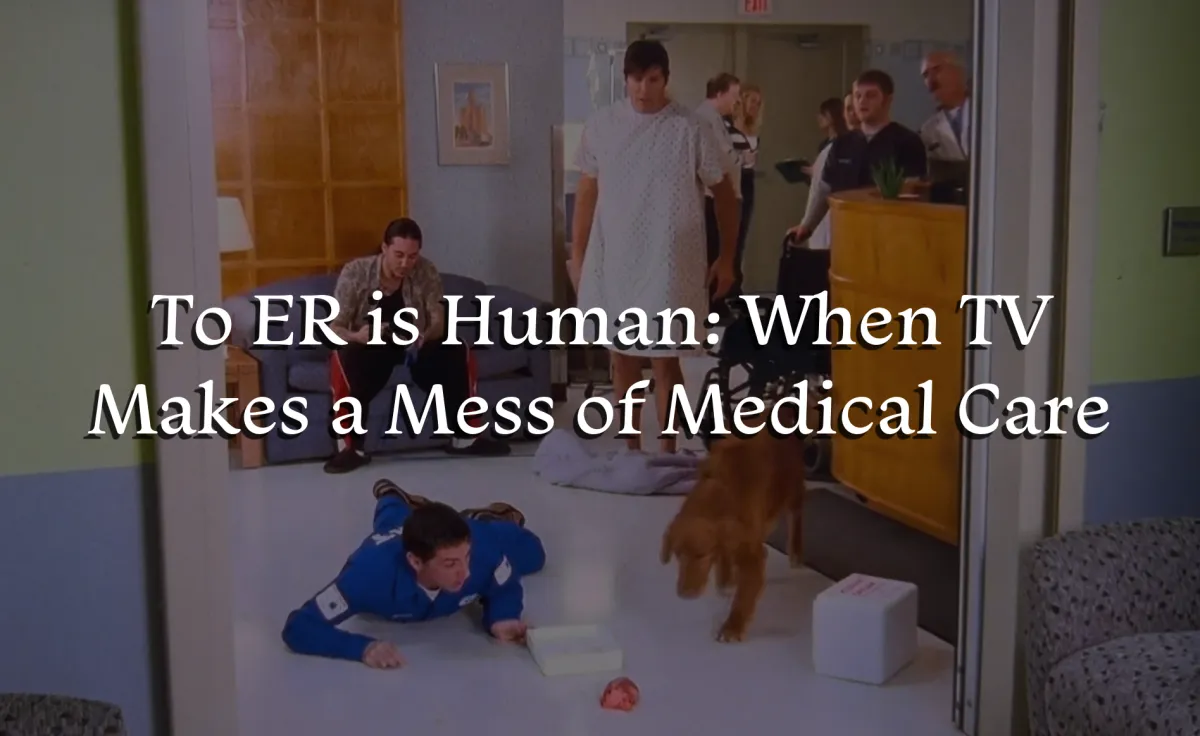
Okay, so this one almost seems unfair. This example is a candidate for one of the worst moments in television history, so highlighting the lack of medical accuracy feels like piling on. It’s so ridiculous that your brain will likely try to protect itself with thoughts like “it MUST be intended as parody” and “well, the dog is cute, right?” But as hard as it is to process, this was intended to be a serious, dramatic scene with emotional consequences… so that’s the lens we must use.
(For those of you who have not seen this, you may want to take a moment to go watch this magnum opus on YouTube, but be forewarned: you will wind up watching a number of times. It’s okay; just take all the time you need.)
Are you back? If so, are you okay? Yeah, it’s a lot to take in. But we’ll get through this together, I promise.
The Scenario:
Since any one part of this scene is enough to give it a failing grade, I’m going to break it down to its most basic elements:
A man sits in the ER waiting room, wearing a hospital gown.
For context, he is eagering awaiting a heart transplant. Possibly to be performed in the emergency room? Hard to tell. But at least we know he’s ready to get things done. We are off to a good start.
He is petting a dog.
No, not a service dog. And not his dog, either. Just a friendly Golden Retriever, who, despite what happens next, is a very good boy.
The dog’s owner is there, sitting in a nearby chair, a leash secured around his wrist. Man is distracted. The leash is blocking the hallway.
The distracted part is key; none of the magic that’s about to unfold would be possible without this man’s Herculean effort to avoid noticing ANYTHING.
An EMT worker in a flight suit rushes down the hallway, holding a styrofoam cooler marked “HUMAN ORGAN for transplant.”
Perhaps the only semi-accurate element in the scene; organs in transit do often carry that warning label. And while the containers used to transport organs can resemble a cooler (and actual coolers were sometimes used in the past), they have a notable feature missing here: a secure lid.
The EMT worker rushes through the entryway.
Forget for a second that the EMT worker was rushing FROM within the hospital TO the ER waiting room, carrying a donor heart like a pizza for delivery.
The dog owner leans away, pulling the leash tight.
The trap is set. What happens next will shock you. (Not really; I think we all know where this is going.)
The EMT trips on the leash, sending the cooler and its contents skittering across the floor.
And by contents, I mean some ice and an unprotected human heart. No covering, no protective fluids… not even the courtesy of some Saran Wrap or a Ziploc bag. (No, we’re not sponsored.)
Everyone freezes.
The heart-recipient-to-be (or not-to-be, in this case), slowly (and I do mean slowly) stands up to assess the situation. Otherwise, no one moves.
No, really. It’s like a Flemish painting. No one goes to help the EMT up off the floor, the EMT is splayed out like a crime scene outline, no one at the desk area bats an eye, and, perhaps most notably, NO ONE TRIES TO PICK UP THE HEART!
The pause is so long that we’ve passed the five-second rule. Which is ironic, considering what happens next.
The dog comes forward and eats the heart.
Throughout this tragedy, the tail never stops wagging. If you listen, you can almost hear the dog’s offscreen trainer giving him the go-ahead.
And the dog’s owner STILL doesn’t look up. It’s incredibly suspicious.
From when the heart hits the floor to full canine cardiac consumption, it takes… 11 seconds.
And during this entire masterpiece, no one says a word. Not a peep.
The dog exits.
Our canine hero, presumably having now acquired a taste for human flesh, trots off down the hallway in search of his next meal. No one tries to stop him.
The camera angle shifts to reveal that the friend of the now-non-recipient was sitting directly in front of the telltale heart. So close that he could have easily kicked it over to his friend like a pericardium-shaped hacky sack (sac?).
Instead, he sat and watched things unfold, as his friend’s new lease on life beat it.
Just heartless.
End Scene.
Patient Satisfaction Score: I'll be honest, I’m not sure I know how to rank this one. So little emotion or reaction takes place here that I don’t get the impression the patient was all that upset. He exchanged a look with this friend at the end that MIGHT have been an emotion, but it’s hard to say.
But the dog? Very happy customer. Would recommend. 10/10.
How does The Pitt do it? With significantly more gravitas. The decision to donate an organ is an important one, and any scenario where loved ones have to face that reality is incredibly difficult. When organ donation is represented on The Pitt, the show does an outstanding job of capturing the emotional impact on family, friends, and the ER team.
And perhaps most importantly: no dogs.
Do you have any favorite medical mistakes we missed? Want to defend your show? Feel the need to point out that actually, there WAS a dog featured on the Pitt? Let us know.
Related:
- What Does a Psychosocial Oncologist Do?
- Routine Procedures: Dr. James Lee on Stillness, Focus, and even Forging Knives
- From Habits to Scrubs: A Brief History of Medical and Surgical Dress