
The advanced procedure treats babies with poor lung development due to a severe congenital diaphragmatic hernia (CDH)
Surgeons at Columbia/NewYork-Presbyterian Morgan Stanley Children’s Hospital have successfully performed the first fetoscopic endoluminal tracheal occlusion (FETO) procedure in New York. This investigational procedure is used to treat fetuses with severe congenital diaphragmatic hernias (CDH) with underdeveloped lungs (pulmonary hypoplasia).
“FETO provides babies with severe CDH a chance to have better lung development by the time they’re born,” says Vincent Duron, MD, Co-Director of Fetal Therapy and Director of the Congenital Diaphragmatic Hernia Program at Columbia. “We can increase their odds of breathing on their own, and can hopefully help babies avoid having to go on extracorporeal membrane oxygenation (ECMO).”
CDH occurs when an opening in the diaphragm during development allows the abdominal organs to move into the chest, crowding the space and limiting normal lung development. During FETO, the surgeon inserts and inflates a small balloon to temporarily block the fetal trachea (windpipe) using minimally invasive fetal surgery. The balloon causes fluid to build up in the lungs, causing them to expand and stimulate lung growth. Because the balloon blocks the airway, it must later be removed via another procedure before or during delivery.
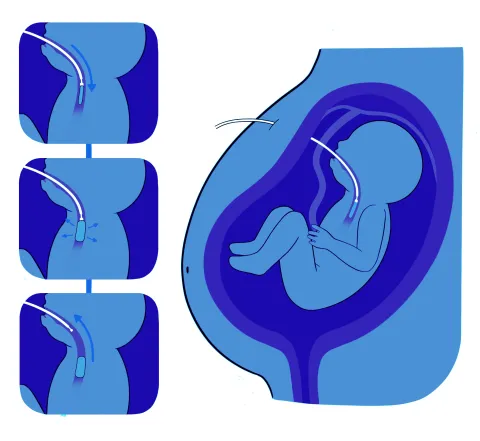
FETO is an investigational procedure reserved for CDH cases where the projected survival rate is low, and carries risks of earlier delivery and prematurity for the baby.
Because of these risks, FETO requires a team of experts across a range of specialties, including prenatal surgery, obstetrics, anesthesia, pediatric critical care, maternal-fetal medicine, ECMO, pediatric airway management, and neonatology. As an established leader in fetal procedures, Columbia’s prenatal surgery team combines the skill, experience, and resources required for complex prenatal procedures like FETO.
“While FETO is still being studied, the results so far have been encouraging,’ says Russell Miller, MD, Co-Director of Fetal Therapy and Medical Director of The Carmen and John Thain Center for Prenatal Pediatrics. “We’re excited to offer this option for families dealing with this challenging fetal condition, and to help these babies survive to a healthier future.”