
On Page Nav:
On Page Nav:
You may have heard about robotic surgery and wondered what it really means for patients. Is a robot actually performing your operation? Will you recover faster? Is it safer than traditional surgery?
These are important questions, and the answers may surprise you. Robotic surgery has transformed how we approach hernia repair, offering advantages that benefit many patients. Let us separate the facts from the misconceptions.
What Robotic Surgery Really Means
The Robot Does Not Operate Alone
First, let us address the biggest misconception. When we talk about robotic surgery, the robot is not autonomously performing your operation. There is no artificial intelligence making surgical decisions.
Instead, your surgeon sits at a console a few feet from you and controls the robotic instruments with precise hand movements. Every action the robot takes is directed in real time by your surgeon. The robot is a highly sophisticated tool that extends the surgeon's capabilities, not a replacement for surgical expertise.
Think of it like power steering in a car. The driver still controls where the car goes, but the power steering makes that control smoother and more precise. The robotic system does something similar for surgical movements.
How the System Works
The Surgeon's Console
Your surgeon sits at an ergonomic console near the operating table. This console includes:
A high definition 3D viewer that provides a magnified, immersive view of the surgical site. Unlike traditional surgery where the surgeon looks at a flat screen, this system creates true depth perception.
Hand controls that translate the surgeon's movements into precise actions of the robotic instruments inside your body. These controls filter out any natural hand tremor and allow movements that would be impossible with human hands alone.
The Robotic Arms
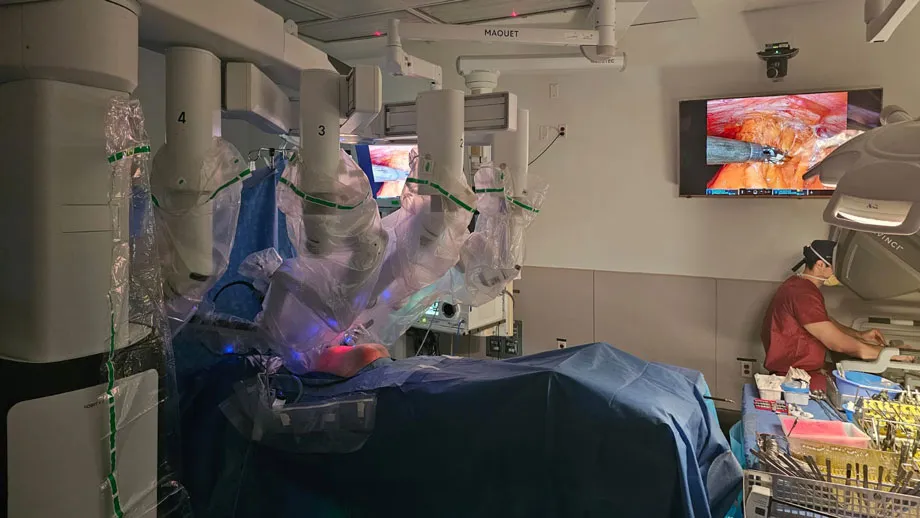
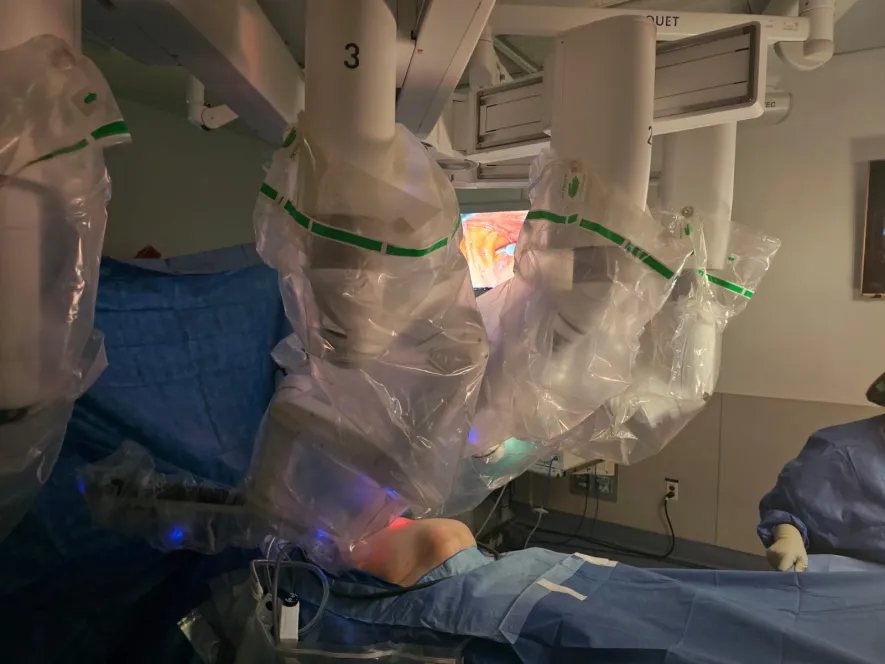
Typically four robotic arms are positioned over the patient during hernia surgery:
One arm holds a camera that provides the high definition 3D view your surgeon sees through the console.
Three arms hold surgical instruments that can rotate 540 degrees, far beyond what a human wrist can accomplish. These instruments can make movements at angles and in spaces that would be extremely difficult or impossible with standard laparoscopic tools.
The instruments enter your body through small incisions (usually about 8 millimeters), making this a minimally invasive approach.
The Benefits for Hernia Repair
Enhanced Visualization
The 3D high definition camera system gives surgeons an extraordinarily detailed view of your anatomy. This is particularly valuable in hernia surgery, where precise identification of nerves, blood vessels, and anatomical landmarks directly impacts outcomes.
Surgeons can see structures clearly that might be harder to identify with traditional laparoscopic cameras. This improved visualization helps them avoid complications and perform more precise repairs.
Superior Precision
The robotic instruments offer capabilities beyond what human hands can achieve:
Tremor filtration: Even the steadiest surgeon has some natural hand tremor. The robotic system filters this out, resulting in smoother, more controlled movements.
Scaled motion: Large hand movements at the console can be translated into tiny, precise movements inside the body. This scaling allows for incredible accuracy.
Articulating instruments: The wristed instruments can bend and rotate in ways that straight laparoscopic tools cannot, making it easier to work in tight spaces and at difficult angles.
Ability to Handle Complex Cases
Perhaps the most significant advantage of robotic surgery is the ability to perform minimally invasive repairs on hernias that would traditionally require large open incisions.
Large ventral hernias, complex abdominal wall reconstructions, and cases involving significant scar tissue from previous surgeries can often be approached robotically. This means patients who would have faced major open surgery with long recovery times can instead have minimally invasive procedures.
Faster Recovery
Because robotic hernia surgery uses small incisions rather than large ones, patients typically experience:
- Less post operative pain
- Shorter hospital stays (many procedures are same day or overnight)
- Quicker return to normal activities
- Reduced risk of wound complications
- Minimal scarring
Most patients return to desk work and light activity within one to two weeks, with full activity resuming in four to six weeks depending on the type of repair.
Is Robotic Surgery Right for Every Hernia?
Where Robotic Repair Excels
Robotic surgery is particularly advantageous for:
- Inguinal (groin) hernias, especially bilateral repairs
- Ventral hernias
- Umbilical hernias
- Complex or recurrent hernias which are not large enough to need open surgery
When Other Approaches May Be Better
Not every hernia requires robotic surgery. Small, simple hernias can often be repaired very effectively with traditional laparoscopic or even open techniques.
Additionally, some patients may have medical conditions that make any minimally invasive approach (robotic or laparoscopic) less suitable. Your surgeon will evaluate your specific situation and recommend the approach that offers you the best outcome.
The Surgeon Matters Most
Here is the most important point about robotic surgery: the technology is only as good as the surgeon using it. An experienced robotic hernia surgeon who performs these procedures regularly will achieve better outcomes than someone who rarely uses the system.
When evaluating whether robotic surgery is right for you, ask your surgeon:
- How many robotic hernia repairs have you performed?
- What is your experience with cases similar to mine?
- Why do you recommend robotic repair over other approaches for my hernia?
The answers to these questions matter more than the equipment itself.
The Future Is Already Here
Robotic surgery is not experimental or futuristic. It is a proven technology that has been used for hernia repair for over a decade. At major medical centers, it has become a standard approach for many types of hernias.
For patients, this technology means the possibility of minimally invasive repair for hernias that previously required large incisions, less pain and faster recovery, and precise surgical technique that may reduce complications.
The goal is always the same: getting you back to your life with the best possible outcome. Robotic surgery is one powerful tool that helps achieve that goal for the right patients.
If you suspect you may have a hernia, our Hernia Experts can help. To set up a consultation or to learn more, please call us at (212) 305-5947 or use our online appointment request form. We look forward to answering your questions and meeting your hernia care needs.
Related:
- The Truth About Hernia Mesh
- What Do I Buy for Hernia Surgery?
- Overcoming Hernia after C-Section and Regaining Life as a New Mom
- See all hernia news