
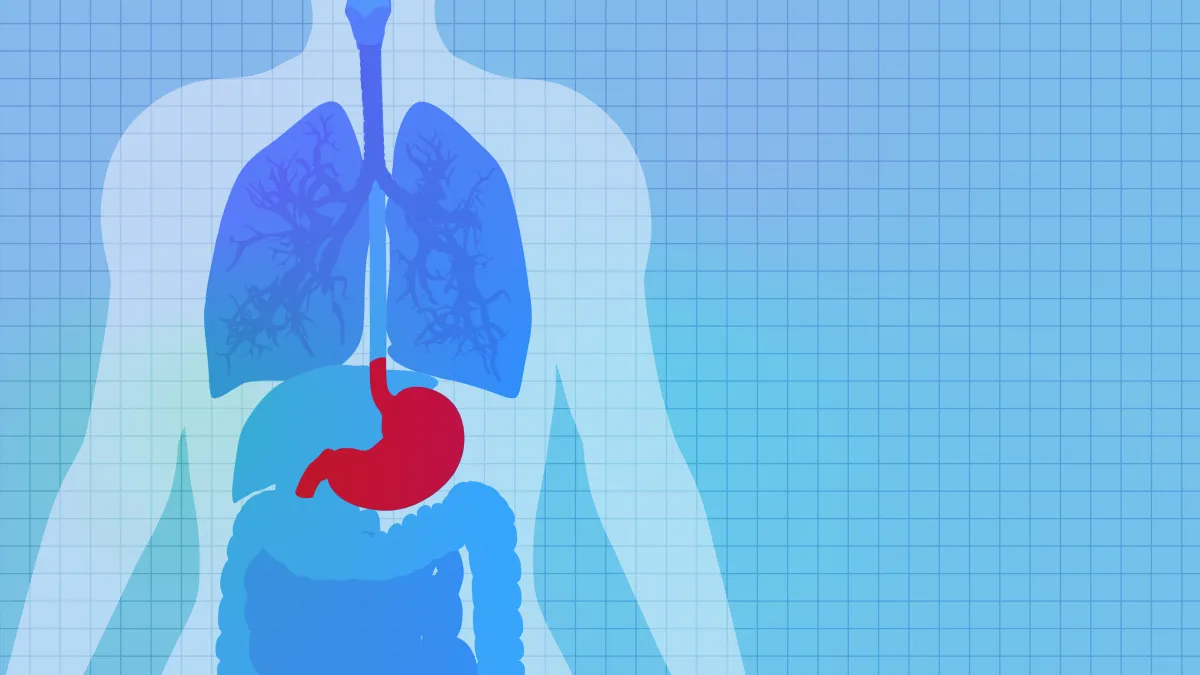
Stomach cancer can be straightforward anatomically, but tumors near the gastroesophageal junction, where the stomach connects to the esophagus, can blur the traditional line between gastric and esophageal disease. Chief of Thoracic Surgery Joshua R. Sonett, MD, endocrine surgeon Beth A. Schrope, MD, PhD, FACS, and radiation oncologist David P. Horowitz, MD, explain why identifying exactly what kind of cancer a patient has is the first step toward deciding what treatment and which expertise they need.
When we think of stomach cancer, are we always looking at a tumor that starts in the stomach?
Dr. Sonett: Not necessarily. It’s common that, to some extent, a cancer involves both the stomach and the esophagus. Some subtypes are definitely more primary esophageal or more primary gastric. It’s not just by location. Some histological subtypes are definitely more gastric; even though they may involve the esophagus, they’re clearly gastric cancers. And then there are esophageal cancers that grow into it.
Dr. Schrope: In this country, we don’t really screen for gastroesophageal cancers, so we often see them later than they do in other countries, like in Asia, for example. Often they present late, so chemotherapy and a surgical approach may be part of the treatment.
So when someone is diagnosed with stomach cancer, how do you determine who should treat them?
Dr. Sonett: Around the country, I’d say it’s not uncommon that whoever they consult first, whether it’s more a primary gastric surgeon or primary esophageal surgeon, their surgery is sort of tailored to that doctor’s expertise rather than the specific tumor, because everybody does what they’re familiar with. But the best approach is to have multiple consultants determine what’s in the patient's best interest.
Dr. Schrope: And just to emphasize multiple consultations, meaning that at Columbia, as a team, we speak about a patient and then direct them. We don’t ask the patient to see multiple people. We’ll decide in a team conference scenario and then get the patient the right treatment.
What does personalized treatment actually mean in these cases?
Dr. Sonett: Their tumor is going to be biopsied to see if there’s a genetic marker of their tumor or an immunologic profile that makes them a candidate for chemo versus immunotherapy versus targeted therapy.
Dr. Schrope: In addition to the tumor genetic profile, particularly the younger patients, but increasingly all patients with GI cancers will be evaluated by our genetics folks. Sometimes we’ll find a mutation in the patient’s genetic profile, not the tumor profile, that may help us with treatment, both medically and surgically.
Walk us through your collaboration process once someone comes through the door.
Dr. Schrope: Well, I think it’s about ten of us, right? If a patient comes to me primarily with a gastric or GE-junction cancer, and if it’s really at the GE junction, I’ll just call Dr. Sonett. We both have tumor boards that involve medical oncology, radiation oncology, radiology, and sometimes pathology. So a patient may come to one person, but they’ll get the opinions of the whole group at some point.
Dr. Sonett: And they’re going to get passed on to the right person. So if they come to me and it’s clearly primary gastric, I don’t want to be anywhere near it because I’m not going to give them the best treatment. Sometimes we end up doing it together. We have to see where it goes, and it may be both teams together in the operating room figuring out the best approach.
Dr. Horowitz: Depending on the stage, of course, there’s usually a recommendation for some sort of preoperative therapy, whether that’s radiation-based or, more and more, chemo- and immunotherapy-based. But it winds up being, like they were saying, a multidisciplinary decision and making sure that people get to the right expert at the right point in their treatment.
How much does the stage of the cancer change what treatment looks like?
Dr. Schrope: Stage is determined by the tumor characteristics, depth of invasion and size, nodal status, and presence or absence of metastases. For the very early stages, endoscopic therapy has the potential to cure, and we’ll often start there if it’s technically possible.
Sometimes we’ll end up with a positive margin, or it’s deeper than we thought, and then we need to move to surgical therapies. In gastric cancer, stage 2 or greater, we will preferentially treat with neoadjuvant chemotherapy followed by surgery.
Dr. Sonett: The endoscopic therapy over the last 10 years is dramatically different. Patients we used to operate on routinely, now we basically never have to operate on because they can be managed with what we’ll call organ-preserving therapy.
So surgery is not necessarily the goal for every patient?
Dr. Horowitz: Particularly for squamous cell carcinomas of the esophagus [cancer that starts in the cells that line the surface of the esophagus], but also some adenocarcinomas [cancer that starts in the glands that line the esophagus], chemoradiation can be an effective definitive treatment.
There’s growing interest in organ preservation and identifying patients who don’t ultimately need surgery if you’re watching them closely. But you really want to be going to a high-volume center to make sure you get appropriate follow-up afterward.
Dr. Sonett: I agree with squamous; I tell patients as much as 50 percent can avoid surgery. Even with locally advanced disease, with chemo and radiation, if they get a complete response, we just follow them.
Which symptoms should make someone take a closer look rather than assuming it is ordinary reflux or another digestive issue?
Dr. Schrope: Certain symptoms are more characteristic than others. Patients who never had reflux before, for example, and now they’re complaining of reflux, we would consider evaluating for a distal esophageal cancer.
The stomach is a really big organ, and the more distal gastric cancers (farther from the GE junction) rarely present with obstruction unless they’re very, very distal near the gastric outlet. But often we’ll see people with anemia. They get worked up, they get iron, and finally somebody does a scan or an endoscopy, and they find it.
We see patients who complain of worsening reflux over months of time. They’re given Nexium and then omeprazole and then something else, and nine months later they have a cancer that is difficult to treat.
Dr. Sonett: Any patients with significant reflux should probably see a gastroenterologist.
What do you want patients to understand at the beginning, before they inevitably turn to the internet?
Dr. Sonett: If somebody Googles this kind of stuff, it can be very scary. The fact of the matter is, we have treatment options for every stage: early, middle, and late. But the treatment options for each stage are completely different.
That is why figuring out exactly what the tumor is, where it started, and what stage it is matters the most.
Related:
- State of the Union: Lung and Chest Care Today
- Routine Procedures: Dr. Schrope on Right-Foot Rituals, Gentle House Music, and the Little Things
- Gastric Cancer: A Concern for Baby Boomers