
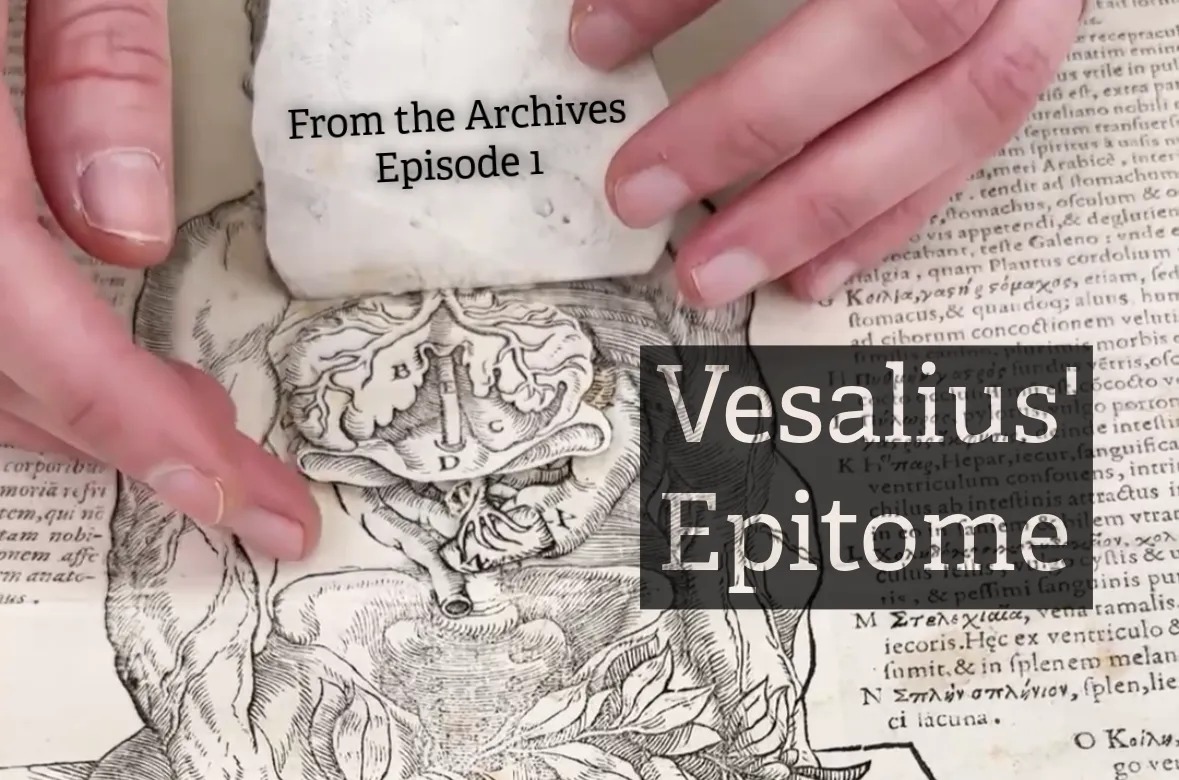
From the Archives is a new monthly series from the stacks of Columbia’s Archives and Special Collections, highlighting rare books and objects that shaped how we study and practice medicine. Each episode takes a closer look at a special, stand-out piece from the collection.
We’re starting in 1543 with Andreas Vesalius and a book that revolutionized the teaching of anatomy.
“We can’t really talk about the history of anatomy books without talking about Vesalius, who was transformative,” says host Katherine Satriano, head of Archives and Special Collections at Columbia University Irving Medical Center.
Before Vesalius, anatomy was often taught at a literal distance. A lecturer would read from classical texts while a barber-surgeon performed the dissection. But Vesalius was totally hands-on. “He’s the first one to really do dissection as a way of discovering more about the human body. And he did his own dissections,” Satriano explains.
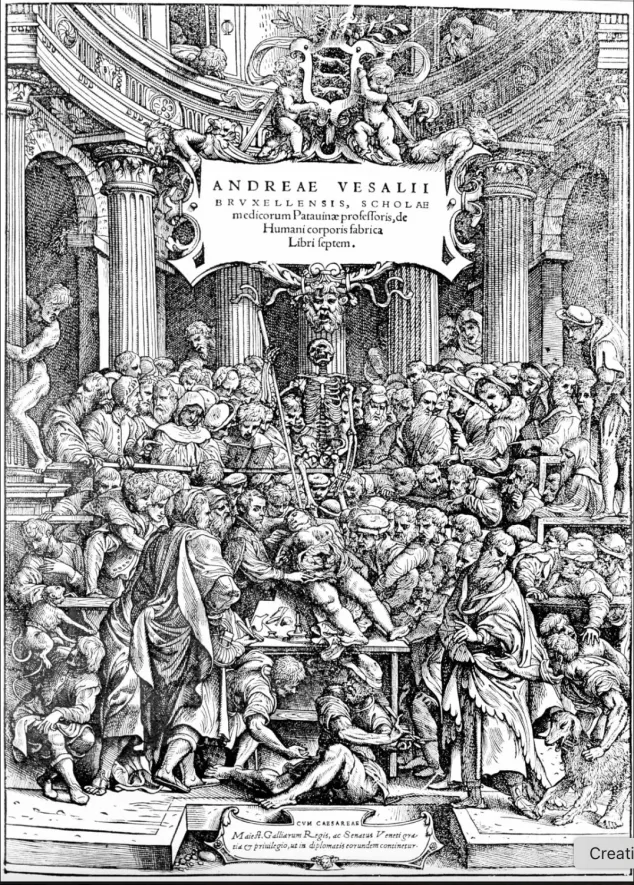
In 1543, he published two books: De Humani Corporis Fabrica and the Epitome. The Fabrica is much more comprehensive and more detailed. The Epitome is shorter, bigger in size, less expensive, and built to circulate. “The Epitome is the kind of Cliff Notes, highlights, version of the Fabrica,” she says.
Because it was more accessible, it was also more heavily used. Pages were ripped out, passed along, and studied widely. “Some of the sheets may have been pasted up onto the wall of a dissection room,” she says. It’s part of why fewer copies of the Epitome survive today than the Fabrica, despite being more widely produced.
The book itself was built for that kind of interaction. Its elaborate woodblock print illustrations are stunningly detailed, and the Epitome includes something unusual, which is not part of the Fabrica: a flap-book meant to be assembled by the reader.
Students could cut, layer, and construct anatomical figures step by step. Not every copy was assembled, but most were, and many were altered in various ways through use. “That’s one of the fun things about early printed books,” Satriano says. “They can differ a lot copy to copy.”
The Columbia copy includes a fun additional detail—a later anatomical flap sheet from the 1580s, bound into the volume. It shows what a fully assembled figure might look like, sitting alongside Vesalius’ original work.
Watch the episode above to see the book up close and stay tuned for the next month’s episode.
Related:
- From Habits to Scrubs: A Brief History of Medical and Surgical Dress
- The Culture Consult: Dr. Craig Smith on What He’s Been Reading Lately
- Decoding Immunity with Computation