
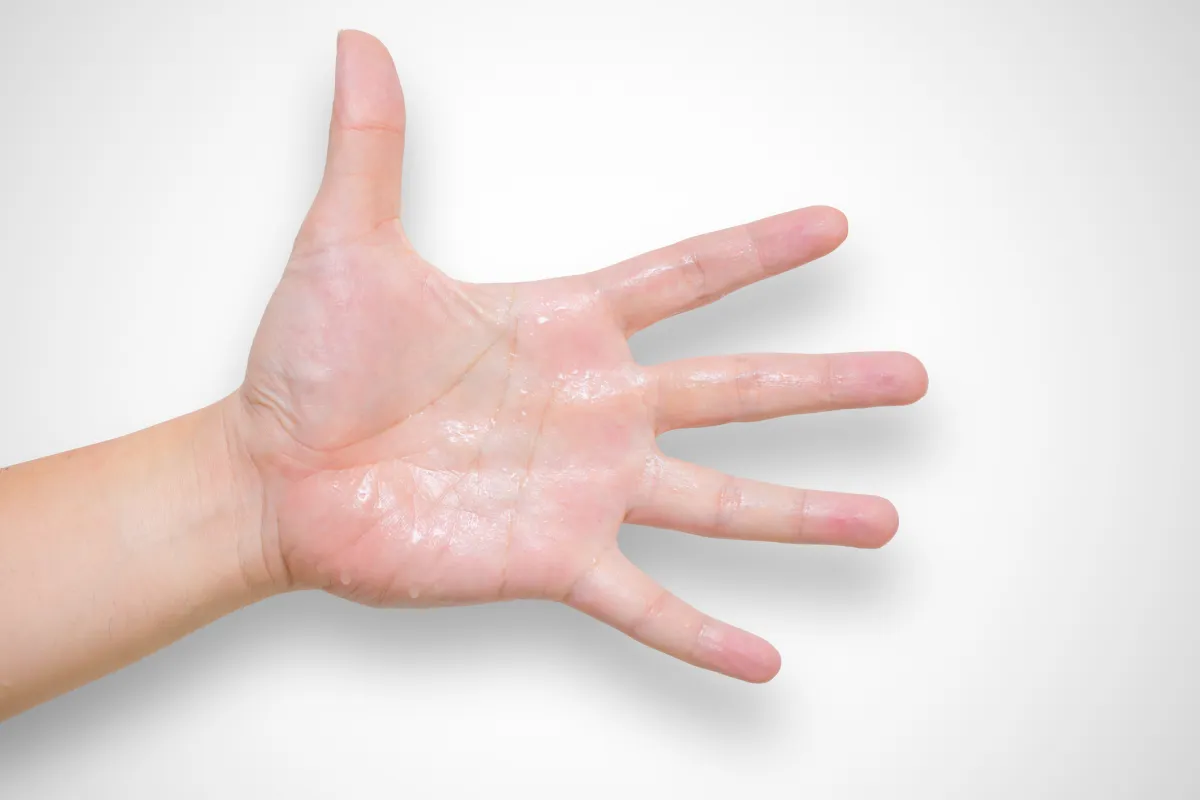
For people with severe hand sweating, endoscopic thoracic sympathectomy (ETS) can dramatically change daily life. But the operation is not meant for every kind of hyperhidrosis, and understanding what may happen to sweating elsewhere in the body is an essential part of deciding whether it is the right treatment. Thoracic surgeon and Surgical Director of Columbia’s Hyperhidrosis Center Lyall Gorenstein, MD, explains who he considers for ETS, how the procedure works, and why patient selection matters as much as the operation itself.
Hyperhidrosis can affect very different parts of the body. How do you determine where to begin with treatment?
You have to think about what areas of the body are predominantly sweating. We obviously focus on people who have hand sweating because I do the ETS procedure. And it’s a very effective operation for people with severe refractory hyperhidrosis of the hands. So, severe sweaty hands that don’t get better with some medical therapies.
The most common presentation that I see is people who have excess sweating of their hands, feet, and underarms; those often go together—the trifecta.
But maybe the area that really bothers them is the sweating of the underarms. Many of them have been doing underarm Botox injections, and they either tire of it because it’s a temporary fix or because of the cost. So we direct them to MiraDry, which is a permanent therapy for underarm sweating. We’ll also get inquiries about facial sweating and often direct them to Botox therapy.
The conversations are largely based on which areas of their body hyperhidrosis is affecting.
How early can severe hand sweating begin?
The other day, I did an ETS procedure on an 11-year-old. Up until then, the youngest had been 12.
When you speak to people with this problem, their parents will confirm that when they were children, two or three years old, they would notice it when holding hands. Some parents will recall that when their children were beginning to walk, they could see the puddles of sweat on the floor. That kind of thing. So, it’s not uncommon for this to manifest in childhood.
People often recollect that it began in adolescence as well. But it’s not uncommon for people to recall that hand-holding, when they began drawing, using crayons, paper, that kind of thing, that their hands were sweaty.
When patients come to see you, do they usually already know about ETS?
It’s a mix. Most of the population with palmar hyperhidrosis have some idea about ETS. Much of it is often misinformation. Many of them have heard about ETS and, in parentheses, I’ll say, about the “horrors of ETS,” with issues with compensatory sweating, which is a common side effect.
The internet and blogs, et cetera, are filled with the stories of people who have had ETS in the past and have severe compensatory sweating.
How does ETS work to change sweating?
After ETS, the nature of the sweating is different. For people with sweaty hands, the triggers are typically anxiety. There’s a region of the hypothalamus that activates the sympathetic nervous system with stimulation, which triggers the hand sweating. Hands and feet often sweat simultaneously. Patients often recall that if their feet start to sweat for whatever reason, that often triggers their hands to sweat at the same time. There is some hypothalamic connection between the two.
After ETS, the nature of the sweating is different. The compensatory sweating trigger is now thermoregulatory. They no longer experience that type of sweating, but they'll manifest compensatory sweating triggered by body temperature. When it’s hot or when they’re hot, if they’re exercising, if it’s summertime, humid weather, sometimes it doesn’t have to be a lot of physical activity that will trigger the compensatory sweating.
Can you walk us through what happens during ETS?
It’s a minimally invasive operation under general anesthesia. Two small incisions in the underarm, and we identify the sympathetic nerve. It runs parallel to the spine. It’s readily visible.
The operation that I do is designed to reduce the sweating in the hands and underarms, but also limit or try and prevent the severity and the frequency of compensatory sweating.
We put a single clip on the sympathetic nerve just beneath the third rib. It’s called a T3 sympathectomy. It’s a misnomer because we’re not actually removing the sympathetic nerve, we’re just putting a clip on it. Above the clip, the sympathetic nerve continues to function normally, and below, it continues to function normally.
It blocks the hypothalamic signal from the brain to the sweat glands in the hands and the underarms. And the hands don’t sweat.
So ETS may also reduce underarm sweating, but severe hand sweating is really what determines whether you offer the operation?
Correct. We do ETS for hand sweating, and sort of a side effect is that their underarms also sweat less. But we select patients who have severe hand sweating, and that’s their main indication for the operation.
You spend a lot of time talking with patients about compensatory sweating. How do you put that risk into perspective before surgery?
When I sit with people, most of the discussion is about the side effects of the ETS. And one of the things we also talk about is potential reversibility because of the technique used, where we’re clipping the sympathetic nerve. There is potential for reversal by taking the clip off.
In actuality, in my experience, very few patients have severe compensatory sweating that is so troubling they seek reversal. It’s under 1 percent of patients. The data on that is sort of mixed. A meta-analysis by a couple of my colleagues in Europe estimates about a 50 percent chance of nerve recovery if the clip is removed.
So that’s one of the benefits also of the technique that we use. It affords the potential for reversibility should the compensatory sweating be severe. Again, that’s infrequent. It’s under 1 percent of patients.
Can you predict who will develop more significant compensatory sweating?
It’s very hard to predict. The thing about compensatory sweating, again, is that it’s extremely variable as to the incidence and severity. The second thing is that different individuals will manage it in different ways, and the impact on them will vary.
I think people with the most severe hand sweating are less likely to be bothered by compensatory sweating because their improvement is so great that they’re very thankful for the quality-of-life change and can cope with the compensatory sweating.
I think someone with mild to moderate hand sweating, if they undergo ETS and then develop compensatory sweating, may not be as satisfied with the outcome. Whereas if you try to select only people with really severe hand sweating, which is what I try to do, you’re less likely to have an individual after the fact who regrets the outcome.
If compensatory sweating does become bothersome, are there treatments for it?
Botox isn’t really going to be practical because compensatory sweating usually involves the trunk areas, the belly, the back, the thighs. As a result, the body surface area is too great to manage with Botox.
Systemic therapy is the only option aside from dressings and common-sense remedies to try to alleviate or reduce compensatory sweating.
What are you listening for when someone comes in asking about ETS?
I prefer patients who, one, are knowledgeable, so I spend a lot of time educating them. Second, I think it’s also helpful for patients to have had medical therapies, or at least some. So if they undergo ETS and have some compensatory sweating, I think it reduces the likelihood they'll regret their decision.
I think what I try to do is be very selective. Spending enough time talking with the individual to find out what their main problem is and making sure that they have a thorough understanding of what the treatment options are, what the expected outcomes are, and especially if we’re going down the road of ETS, that they’re aware of the impact it’s going to have on their quality of life and especially regarding the side effects.
What is the operation and recovery actually like?
It’s safe. I’ve done over 4,000 of these. It’s outpatient. Everyone goes home the same day. And for the right individual, it’s life-changing. It’s very quick. People are back to school or work within a day or two.
Can compensatory sweating itself change over time, years after surgery?
That’s a good question. And I think perhaps yes, because in adolescence, like I will do ETS on a lot of teenagers, I think they’re less likely to have compensatory sweating. Again, that’s purely observational. I don’t have any data that supports it.
But it seems to me that adolescents are less likely to have compensatory sweating than they might be in their 20s and 30s. So over time, yeah, people might find that as they age, they may have more compensatory sweating.
On the flip side, some people's compensatory sweating declines over time. It’s unclear what that means. That’s not a common observation, but some people have noticed their compensatory sweating becomes less significant. Perhaps they develop coping mechanisms, or they just adapt. It’s unclear.
There is also a curious effect on foot sweating after ETS, right?
Another interesting observation, which we don’t truly have a full physiologic explanation for, is that after ETS, 50 percent of people will find that their feet sweating also improves.
And that 50 percent incidence has been very consistent over time. It doesn’t matter whether it’s people who have a simple T3 like I do, or people who have a more extensive sympathectomy. The data also consistently show about 50 percent of patients improving in sweating.
Physiologically, it shouldn’t happen because the sympathetic innervation to the feet comes from the abdomen, not from the chest, and the sympathetics in the abdomen are intact. They aren’t impacted by ETS. So what that mechanism is, is it some kind of biofeedback mechanism, some kind of learned behavior? It’s unclear.
For someone considering ETS, what do you most want them to understand before making that decision?
I think what I try to do is be very selective. Spending enough time talking with the individual to find out what their main problem is and making sure that they have a thorough understanding of what the treatment options are, what the expected outcomes are, and especially if we’re going down the road of ETS, that they’re aware of the impact it’s going to have on their quality of life.
I like to pride myself on providing people with ample time to learn about ETS, learn about its treatment options, and, especially when it comes to ETS, be knowledgeable about the common side effects. For the right individual, it’s life-changing.