
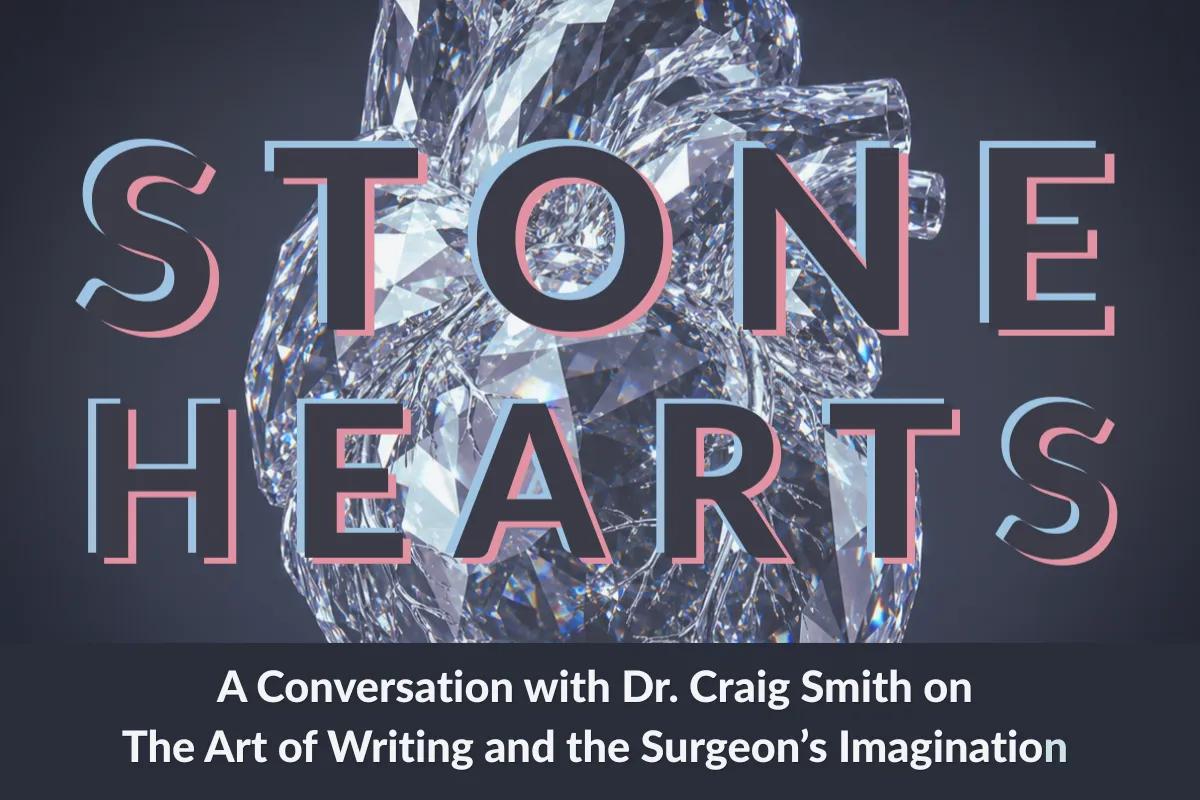
Craig R. Smith, MD, has spent most of his life in the OR, where consequence is immediate. As a cardiac surgeon, former Chair of the Department of Surgery, and author of memoir Nobility in Small Things, he has written widely across the terrain of medicine, leadership, accountability, and the interior life of a surgeon. And now with Stone Hearts, the traverse of fiction.
Every Friday, we’ll share a new chapter of Stone Hearts in serialized form, alongside its Wednesday release on Dr. Smith’s Substack, Long Incision. The book is a medical caper of sorts, rooted in transplant, set in the 1980s, and animated by the pleasures and perils of making something entirely imagined from a life spent in one of the most exacting professions there is, heart surgery.
To accompany this serial release, we spoke with Dr. Smith about the writing process, cross-section of craft and surgery, and all the nuances in between.
You’ve spent your career in one of the most disciplined, high-stakes forms of work imaginable. What did fiction allow you to do that surgery, leadership, or even memoir did not?
It came as a surprise to me, honestly, when I sat down and actually wrote some fiction, that it was much more fun to do than writing the sort of worky, professional stuff that I'd been doing for 50 years.
So I guess I sort of knew I wasn't that excited about grinding out essays all the time. If you've been following the Substack, you know I'm still doing some of that. But when I started diving into the business of actually creating a whole new world, that's got its pleasures.
You have your finger on all the dials, which you can't do in surgery, and you can't do in science. There's quite a bit of creativity in science, of course, but in fiction, it's really kind of humbling to have it all come out of your head.
Indeed. Surgery has its own kind of relationship to suspense. There’s uncertainty, timing, consequence—did that translate into your relationship with writing?
Well, if you mean in the process of the writing itself, maybe not so much. I have learned that you have to be able to ship it, so to speak, and finish. You have to close the sternum.
Although one of the things that's also conversely the most pleasurable about writing in general, but I found in fiction in particular, is that you can infinitely revise. There isn't a sternal closure. There is when you decide it is.
It’s been credited to Paul Valéry, who said, “No work of art is ever finished, it's only abandoned.” I think many people have probably said that one way or another. And so, until you decide to abandon it, you can hopefully keep improving it.
You’ve spoken before about surgery as a performing art. Does writing feel performative to you in that way?
Not in quite the same way. It shares the necessity of putting yourself out there. Exposing, you know, taking chances.
But it's done in a different time-space or something, because the actual performance, when you're playing the piano or operating, is right then and there. And that's one level of embarrassment, but the exposure when you've written something, and it's out there, and God knows how people are reacting to it, that's a different form of performance anxiety.
Do you feel that anxiety while you’re writing, or only after it’s out in the world?
Not so much. No, in fact, maybe like surgery too, I'm always very confident while I'm doing it.
One of those unresolved contradictions of my own is that I don't seem to have any trouble operating, but I cannot perform in other things anymore. I can speak, but things like playing the piano for people, I can't do.
After a life spent doing work that is so tangible and precise, was there discomfort in moving into something whose value is imaginative?
Yeah, that's quite a Rubicon. And particularly now that I've stopped operating.
That alone is a blow if you've done it as long as I have. It's so much fun, how can writing possibly replace that? And I'm not even trying to; it's such a different set of inputs and feedback. You do get into your head a little deeper than maybe is healthy.
Your nonfiction has a very recognizable voice—the COVID updates, your memoir, essays and speeches. Did you consciously craft a different voice in fiction or let the work pull that out?
In the novel, I was much more conscious of that. I feel like the other stuff, the professional stuff, that's me, that’s my voice. That's how I think, how I talk.
I was quite a bit more self-conscious in the search for the voice in the novel, and that may be because I've never done it before. Without really making it a conscious effort, I've broken up the history of the different characters, and I think I ended up with somewhat different voices by necessity.
I’ve described the book as a caper, but is that the type of story you set out to create?
My editor, my agent, and a couple of other people read this and claimed to have liked it but weren't sure they could make it commercial. They all categorized it as you did, as a caper. And that’s fine, there are plenty of very successful capers. But I was thinking, if that's what you don't like about it, what makes a caper a caper, as opposed to Proust or whatever? And my editor said, consequence.
I see what she's getting at. Have I stripped out some of the consequences? Not that the plot itself has to be full of deep consequence, but maybe you can have more if I better characterize the human moving parts.
I’ve only read the first chapter so far, but I know the book has a transplant at its center. What made you want to write about transplantation in the novel?
I had this idea very early in my career, actually, when I was doing a transplant run to Montreal. And it was somewhat unusual because I’m mostly on the recipient side.
But one of the things that makes transplant such a hook is its complex set of relationships. Somebody gives their heart, somebody takes a heart. And there's all this stuff in the lay literature about whether you acquire the personality with the heart and things like that. Things I've had patients tell me over the years, they're just hard to believe. I mean, they're so, so moving.
Has this new chapter of life, quasi-retirement, changed your relationship to time?
Probably so. If you hadn't put it that way, I would have said that my relationship to time has changed so dramatically by having my professional life change. Because I always had time to write. That's how I wrote the other book, waiting for the case to start or end. Sitting around, endless hours of wasted time here and there during a long day.
The 10 hours of actual operating are gone. If you're used to working 12, 16-hour days, you don’t have to have much work ethic to work writer's hours.
Discipline can be the toughest battle, and you came into writing with decades of it. So, what does your actual writing routine look like now?
I have made it a point to sort of self-educate on how writers do what they do. And it's very common, you get up in the morning, have your cup of coffee, write 1000 words, then go out and play. And when you add up those 1000 words, they mount up.
So I'm relatively quick at that. But I spent a lot of time on the refinement and revision.
In fiction, you have to make things go wrong. Was there any pleasure in allowing that, after a career spent doing the opposite?
Oh it’s fun, I would say, since it's mostly made-up. If the goal is to make it interesting to read, some bad stuff has to happen. Or at least there has to be some tension. You have to have some trainwrecks, and you get to make up the trainwreck yourself.
Is there anything that fiction may allow you to get right about medicine that nonfiction can’t?
I'd like to think nonfiction could do it as well, but maybe nonfiction cannot really get at the emotional elements, because people just aren't that forthcoming.
Fiction might arguably do a better job of showing what's going on in the heads of surgeons, patients, what have you.
Did you have to resist making the medicine too accurate or too complete?
To some extent. Because I think there would be just too much detail. I could easily get into a level of detail that makes perfect sense to me. Deciding how much medical jargon to use and how to walk the line between recreating the scene the way I would talk about it, versus for a lay audience. To me, constantly parenthesizing gets clunky and even condescending.
If the point is for the reader to see what happens in an operating room when somebody's putting a heart in, well then, they're going to see how it happens and how people talk and all that.
You set the book in the 1980s. Why that era?
First of all, as I mentioned, I got this whole idea in the 80s.
In 1985 or 1986, I did that donor run to Montreal. So flying there and back and having to deal peripherally with the notion of customs got me thinking: Where could you go with this? What are the twists and turns?
They used to move the whole donor. Plus, I heard from one of the original organ transplant guys, who worked with Keith Reemtsma in the 70s, about a time they brought a whole donor from Canada. When they got to Teterboro and had to bypass Customs, they actually sat down on the tarmac in folding chairs to discuss whether or not they were bringing in anything of declared value.
They sat down and debated. And they decided they weren't bringing anything of monetary value. Then, customs just let them go. So that's where the plot started.
Wow. Could a version of this story even happen now?
A lot of what happens in this story couldn't happen with cell phones. Because you have to wait for the call. And payphones play a significant role in anything where you do not want to be known or disclose your location. And then the surveillance cameras and all the other stuff that happens today, that would make many, many plots impossible.
What made you wait so long to start writing this story?
Well, I did this donor run and had this idea early in my career. I quickly came up with a pretty complete outline. And I'd written 5 chapters then on this very plot. But I was writing on my old plug-in IBM desktop computer console from ancient history. So, it was all in that machine. I didn't even have a laptop at home or anything.
And I looked back over them a few times and thought I'm not sure this is working, and sort of threw it in the equivalent of a bottom drawer somewhere, didn't think about it for months. Then I come in one morning, and my computer's gone. It had been stolen. True story.
The next day, I go to report it stolen, and they look at the cameras and see the guy carrying it out under his arm. I hadn't backed up anything, of course, because we didn't back anything up. But all my work, not just that, gone.
I said, well, that's the end of that. And then when I was having discussions with my editor and my agent about what else I could write, fiction, non-fiction—this was one of two or three ideas I gave them.
It was pretty easy to bang out the first draft, but then it's been refined and refined and refined, and I hope getting better all the time.
Did writing fiction make you more forgiving of people?
Maybe. I've certainly had to be more forgiving of some of my characters. Thinking that nobody's that black and white. I think if anything, I have a tendency to make everybody too gray and likable and amusing, no matter how evil they are.
What do you hope readers take from the book?
What writer shouldn't be able to answer that question in a heartbeat? But maybe I need to think more about it—which gets back to the caper thing. Since it started as a cool plot and everything is built on top of that, I guess I want them to take pleasure in the plot.
Read Stone Hearts:
Chapter 1: Eva
Chapter 2: Elias
Chapter 3: Give
Chapter 4: Take One
Chapter 5: Donor Flight
Chapter 6: Take Two
Chapter 7: Take Three
Chapter 8: The Brothers Bessette
Chapter 9: The Third Man
Chapter 10: Mulberry Street
Chapter 11: The Finish
Chapter 12: Loose Ends
Chapter 13: Acid Test
Chapter 14: Dulciena
Related:
- Lessons Learned: Surgeon Craig Smith Reflects on Career in the OR
- For Us the Living: Reflections on 9/11 from Dr. Craig Smith
- “The Sacrament of Utility” Dr. Craig Smith’s 2025 Commencement Address at Case Western Reserve University School of Medicine
- Nobility in Small Things: A Look Back at The Leadership of Craig Smith, MD
- Book Review with Dr. Craig Smith — The Conscience of Care: Navigating Health in the Culture Wars