

A surgeon’s life is defined by long hours, exacting focus, and countless critical decisions that impact the lives of others. They go through years of training to develop a stamina that can sustain the deepest, complex pressures. But just like the rest of us, they rely on small rituals and routines to keep their days steady, mind sharp, and energy plugging along.
In Routine Procedures, we’re taking a closer look at the daily habits—from breakfast choices to favorite shoes—that shape our surgeons’ work and life.
No Snooze, Just Coffee
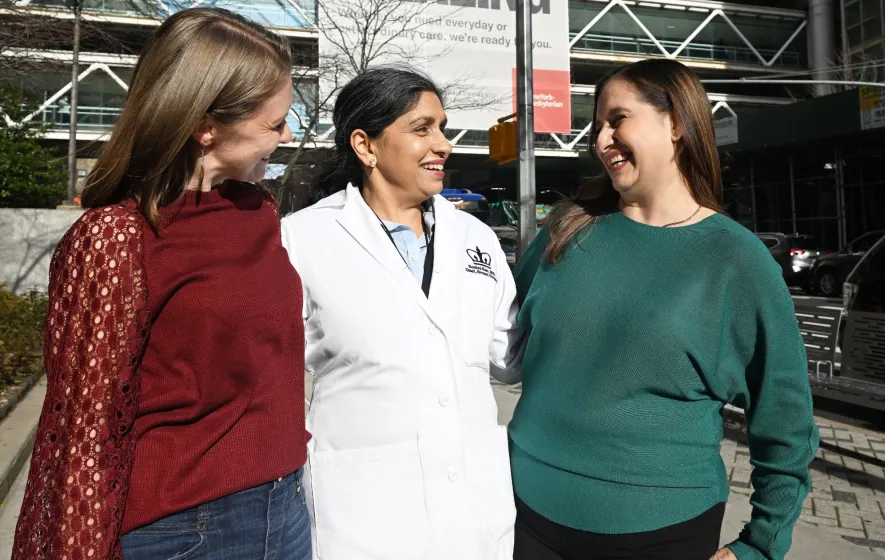
Roshni Rao, MD
Chief of Breast Surgery
What time does your alarm go off in the morning?
5:30 a.m.
Snooze or no snooze?
No snooze, never snooze!
Breakfast of choice (especially before a big day)?
Just coffee. I hate to admit it, but yes, just coffee. With cream and sugar though, does that count for something?
First thing you do when you get to work:
Okay, I don’t know. Just turn on the computer? Yes, I guess it’s right to the computer.
Do you have any pre-op rituals or routines?
I get my glasses on. You have to put the glasses on first, and then the hat, and then you’ve got to put on the mask. You have to do it in that order. Otherwise, your glasses aren’t in the right spot where you can manipulate them. I guess that’s the only thing that’s kind of a ritual. But if you do it out of order and then you scrub in, you’re uncomfortable for the rest of the case.
Is there music in your OR?
Yes.
Who picks it and what’s on the playlist?
I pick it, usually a Pandora channel called “Happy Music,” or something like that. I like everything, but it’s mostly pop, which is fun. The happy channel is peppy, but there are no bad words in it, so you’re not going to offend anyone.
Favorite shoes for long days standing in the OR:
Yes, for sure. I wear one of two types of shoes. I either wear Merrells, which are generally known for walking shoes, but they have a nice stiff one as well, or I wear Keens, which are work shoes, like the kind carpenters wear. You’re able to stand in them and they give you good support. I was a clog person for many years, but that started hurting my back, so I had to switch.
Favorite part of your day:
Probably meeting with patients. And at the end of the case, I like calling the family and telling them that everything went well. Our days are so different, clinic versus OR, so it just depends on what you’re doing.
What’s always in your lab coat pocket or bag?
I’m a snacker on my OR days. When I’m doing like four or five cases, I tend to have several snacks. Usually, it’s going to be some sort of nut thing, like cashews or peanuts, and then something sweet. I have a lot of Lara Bars, so a protein and a sweet. Between those couple of things, I can usually get through most of the day.
Any non-medical habit that helps you stay focused?
I work out. I exercise three or four times a week, very regularly. I run at least once a week. I try and do yoga, but it’s a little bit too slow for me, so I only manage to do that once a month.
Most underrated part of your job:
I make it a point to always be there when my patients are going off to sleep. I find that important because I think it’s a very vulnerable time, you’re in this loud, cold, clangy room, strapped to the bed, not really knowing anyone except for me. So, I always make it a point to be there. A lot of surgeons want to be there once the patient’s prepped and draped, which is good and fine, that works for them. But I think for me, I always like to be there when they’re going off to sleep.
When you finally get home, what’s the first thing you do?
Change into my pajamas. That is my favorite. I’m a slipper person too, and I have really comfy pajamas for winter and other ones for summer. And then I eat, of course.
If one of your patients saw you outside the hospital, they’d be surprised to see you…
Probably jogging and running. I run in Central Park, and I’ve seen patients there. It’s always a nice hello. I’ve seen surgeons too, it’s a popular place! I run into Dr. Ascherman, our plastic surgeon there. I like it.
More routines:
James Lee, MD
Chief of Endocrine Surgery
Abe Krikhely, MD
Chief of Minimally Invasive Surgery and Bariatric Surgery
Roshni Rao, MD
Chief of Breast Surgery
John Chabot, MD
Chief of GI/Endocrine Surgery
Executive Director of the Pancreas Center
Jason Hawksworth, MD
Surgical Director, Adult Liver Transplantation
Chief of Hepatobiliary Surgery, Division of Abdominal Organ Transplant and Hepatobiliary Surgery
Emile A. Bacha, MD
Chair, Department of Surgery
Surgeon-in-Chief, NewYork-Presbyterian Hospital / Columbia University Medical Center
Virendra I. Patel, MD, MPH
Chief of Vascular Surgery
Co-Director of Aortic Center
Christine H. Rohde, MD, MPH
Chief, Division of Plastic Surgery
Chief of Microvascular Services
Vincent Pierre Duron, MD
Pediatric Surgeon
Thomas A. Imahiyerobo, MD
Director, Cleft and Craniofacial Surgery
Section Chief, Pediatric Plastic and Reconstructive Surgery
Francisco Guzman, MD
Bariatric Surgeon
Beth A. Schrope, MD, PhD, FACS
Director, Autologous Islet Cell Transplantation Program, Pancreas Center
Katherine Fischkoff, MD
Chief, Division of General Surgery
Executive Vice Chair for Operations, Department of Surgery