
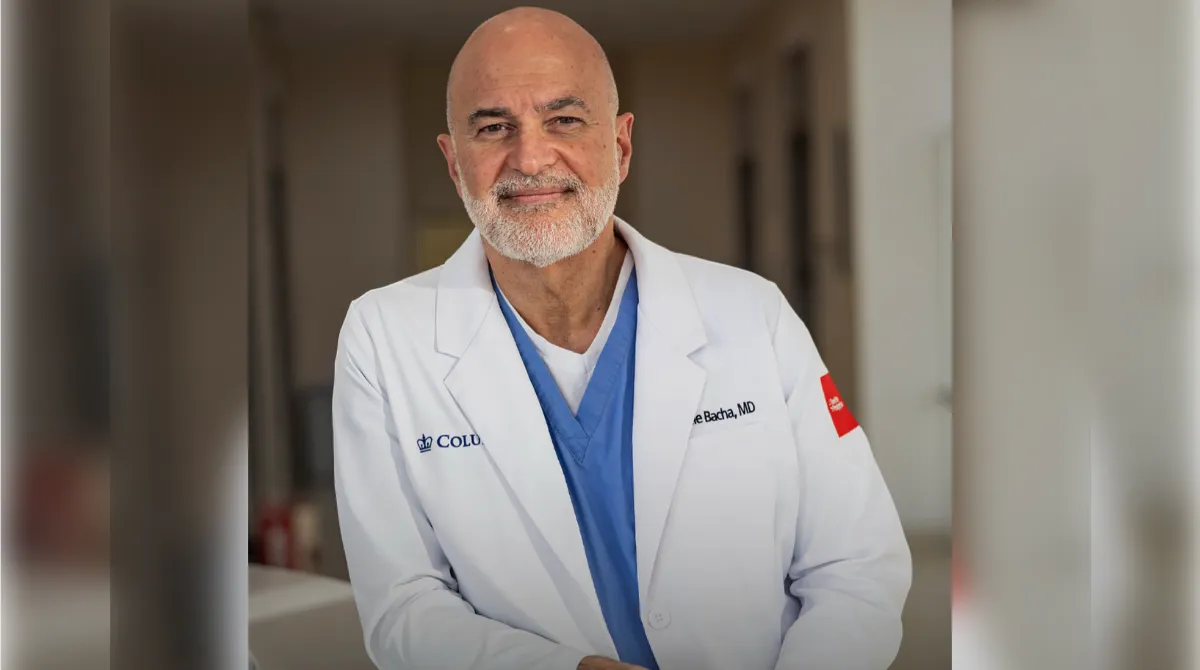
We sat down with Chief, Division of Cardiac, Thoracic, & Vascular Surgery and pediatric heart surgeon, Emile Bacha, MD, as he steps into the role of Chair of Surgery at Columbia University Irving Medical Center and Surgeon-in-Chief at NewYork-Presbyterian, Columbia’s hospital partner.
A longtime leader within the institution and an internationally respected surgeon, Dr. Bacha speaks candidly about what has surprised him in the transition, what leadership has taught him over time, the impact of outgoing chief Dr. Craig Smith’s legacy, and why culture, people, and patient care remain at the center of his vision for the department’s future.
As you step into the role as chair, what surprises you most about the day-to-day of that transition?
Just to go back, I trained as everybody did in those days in general surgery and took my boards in general surgery, so I have that understanding. But I realized fully that my understanding of general surgery is thirty years old.
So it’s actually been exciting. I’ve been surprised at how interesting it’s been to relearn the non-cardiothoracic side of surgery and to see how it has shifted with the development of robotics and the prevalence of robotic technology. That was not something I was completely on top of.
I’ve also seen how the field has sub-specialized into much more focused lanes. Now, if you need pancreas surgery, you’re going to go to a pancreatic surgeon. If you need liver surgery, you’re going to go to a liver surgeon, you’re not going to go to a general surgeon, by and large.
That presents particular challenges, but it’s also a good development for patients. And for me, it’s been fun and exciting to get to know the other side of the department that I didn’t really pay much attention to before, and to get to know the surgeons better. They’re great people, with a lot of deep expertise.
What does it mean to inherit a legacy like Dr. Craig Smith’s, and how do you see your leadership continuing or evolving that work?
Dr. Smith’s legacy…those are very big shoes to fill. He covered all the bases. He was an amazing cardiac surgeon, an outstanding educator, mentor, and leader. His leadership during COVID is one part of that, but what I saw most closely was his day-to-day leadership. I’m still very close to him.
This is a big job that I’m getting into. At the same time, I recognize that the future is always different from the past. We have to move forward and think about what the future brings and how to position the department for what’s next.
The department has been very heavily developed in cardiothoracic surgery and transplant, and in some pockets like endocrine. In other areas, it needs work, and I’m looking forward to doing that work.
How has your experience leading teams through complex situations shaped your philosophy of leadership?
I’m glad I’m not coming into this job without leadership experience. Nobody comes into a chair job without it. But it is particularly important.
A hallmark of leadership is that you keep learning. You have to have an open mind. You want to learn from other people, and you want to apply what you learn about yourself as a leader.
I was in a leadership position very early on, almost since finishing training. I led the congenital heart center at the University of Chicago when I was very young. I made mistakes. But I’m proud to say that I noticed those mistakes myself and learned from them.
Nobody is born a perfect leader, I can assure you that. The important thing is that you look inward, acknowledge your biases because we all have them and become a better leader by constantly working on yourself and benefiting from the wisdom of others.
How do you think about the human side of leadership? Emotional clarity, ethics, and understanding the people you lead?
That’s very important. There are technical aspects of leadership, setting up a department, understanding budgets, technical aspects of medicine. And then there’s emotional clarity, ethics, understanding where someone else is and what their needs are, and how you can help them.
Surgeons, in my opinion, require a different type of leadership. A surgeon is someone who has gone through medical school and surgical training. That already places them in a different category in terms of performance and capability.
Each surgeon could, in another life, be a CEO somewhere, or a top-notch lawyer. They deserve respect. They deserve to be heard. And they need leadership that understands that this is a special group of individuals doing special things, different from most other teams.
What do you hope the culture of the department embodies over the next five to ten years?
Culture is incredibly important. It took me a while to understand the saying “culture eats strategy for breakfast,” but I fully agree with it now.
First and foremost, the culture has to be one of ethical patient care. None of us became surgeons to stay in the lab or the classroom; we’re here to take care of patients in the ORs and ICUs. That has to be done the right way, ethically and responsibly.
Beyond that, we have the triple mission [Dr. Bacha is referring to the three-part mission of an academic medical center: serving patients, advancing research, and educating]. We must educate the next generation. Medical students deserve special care and empathy. They’re at a difficult point in their lives, trying to decide where to go professionally. Residents and fellows deserve the same attention.
And then there’s discovery and innovation. In a place like Columbia, one of the top academic centers in the world, we have to push the field forward. We are doing that, and we need to keep pushing.
How do you balance your commitment to being in the OR with the responsibilities of Chairman?
That’s a problem; it’s a great problem. I love being in the OR, and I have a lot of patients who want to come here for surgery. I wish I could duplicate myself, but I can’t.
I have excellent collaborators and colleagues who take on a big load. Still, with this new position, I am going to cut back a little, not much, but formally. I used to operate four to five days a week for many years. I’m going to be very strict about devoting two days to departmental work and three days a week in the OR.
It helps to like what you do, and to have an understanding spouse.
What parts of your clinical identity feel essential to bring into this role?
My clinical identity is, for sure, as a surgeon, not just a pediatric cardiac surgeon, but a surgeon. Surgeons do invasive things to people to help them. That’s what defines us, whether it’s the heart, the chest, or the abdomen.
What excites me most is helping the department move toward the future and shaping that future together. There are a lot of things we can do, and I’m very excited about what’s ahead.
When you think about shaping that future, what matters most?
People. People are everything to me.
We need the right people in the right places. By and large, that’s what we have. We need a few more, and that’s what I’m focused on.
Related:
- Routine Procedures
- State of the Union: Pediatric Heart Surgery
- Nobility in Small Things: A Look Back at The Leadership of Craig Smith, MD
- Surgery Wrapped 2025: What a Year of Care Looked Like