

A surgeon’s life is defined by long hours, exacting focus, and countless critical decisions that impact the lives of others. They go through years of training to develop a stamina that can sustain the deepest, complex pressures. But just like the rest of us, they rely on small rituals and routines to keep their days steady, mind sharp, and energy plugging along.
In Routine Procedures, we’re taking a closer look at the daily habits—from breakfast choices to favorite shoes—that shape our surgeons’ work and life.
One Snooze, No Music, and Focus at the Scrub Sink
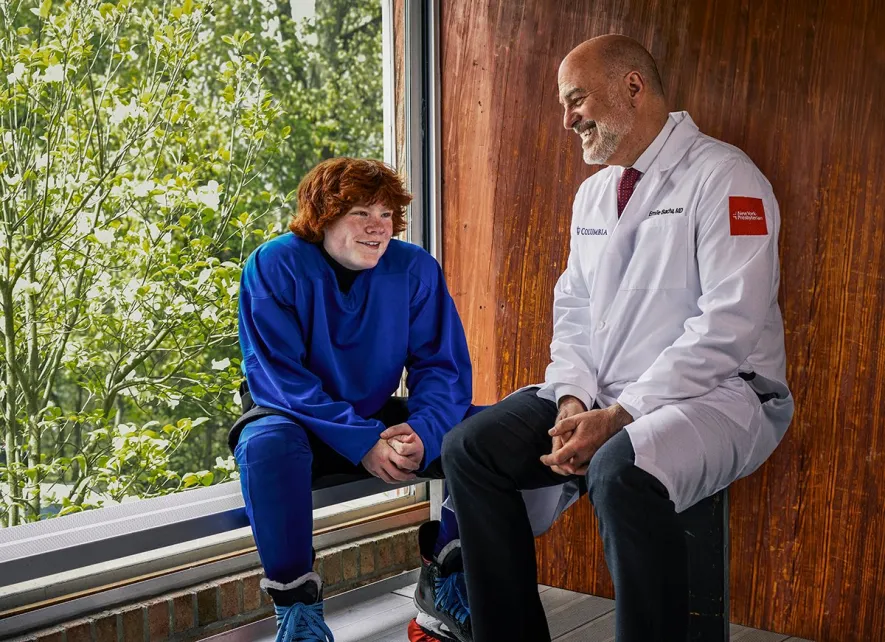
Emile A. Bacha, MD
Chair, Department of Surgery
Surgeon-in-Chief, NewYork-Presbyterian Hospital / Columbia University Medical Center
What time does your alarm go off in the morning?
Between five and five fifteen.
Snooze or no snooze?
Snooze for sure. Ten minutes, one snooze. That’s it.
Breakfast of choice (especially before a big day)?
Coffee. No breakfast often.
First thing you do when you get to work:
Coffee, and, you know, I log on my computer and then go see patients.
Do you have any pre-op rituals or routines?
It’s a good question. Not really. I’m not big into rituals and routines. But I mean, you don’t want to have a full bladder.
But mostly, you need to free your mind and focus and be in the zone. That’s probably the most important thing. And I usually do that, now that I’m experienced, at the scrub sink. I’m scrubbing, I’m washing my hands, and I’m completely forgetting everything else and focusing on what I need to do for the case.
Is there music in your OR?
No music.
Goldstone [colleague Dr. Andrew Goldstone] and I have an ongoing argument about this, because he plays music in his room. I like to tease him, but he plays music and he likes it. And of course, if that relaxes him, that’s great. I don’t like to have music. It distracts me, I like to have quiet.
Favorite shoes for long days standing in the OR:
I use running shoes, and I have a pair of slippers that I like to use. I like to change a little bit. I’ve also been wearing compression stockings recently. That’s something I didn’t used to do, but I’m trying to get used to them.
For long cases, if I’m going to be standing all day, I think it’s a good thing to do.
Favorite part of your day:
I’m not sure I have one. I mean, relaxing at the end of the day with a glass of wine or a nice whiskey is definitely a good part of the day.
What’s always in your lab coat pocket or bag?
A pen and glasses. That’s it.
Any non-medical habit that helps you stay focused?
Over the last several years, I’ve been very disciplined about working out with a trainer who’s helped me enormously with neck pain and back pain.
Pediatric cardiac surgery, in particular, is such that your neck has to be cranked down because of the angle to look inside the chest. It’s very bad for your neck. A lot of my colleagues have had neck surgery, back surgery, all sorts of things.
I was starting to feel pain, and so I work out with the same trainer—he actually focuses on surgeons and works with a lot of surgeons. He’s great. He’s really rescued my back by focusing on the back. It’s pretty hard, but it’s good, and it keeps me healthy.
Most underrated part of your job:
Oh my God. Underrated part of my job. I think, administration. It’s important to do good administrative work, and that’s probably underrated by surgeons.
When you finally get home, what’s the first thing you do?
I change, put sweats on, say hi to my wife.
If one of your patients saw you outside the hospital, they’d be surprised to see you…
I don’t know—it might be surprising to see me, period.
I think patients see surgeons as people who just live in the hospital and never have a normal life outside of it. And I do work long hours, twelve, fourteen-hour days, often weekends, but I do have a normal life outside. I go to parties. I go to dinner. So they might be surprised and say, “Oh, he’s like a normal person.”
More routines:
James Lee, MD
Chief of Endocrine Surgery
Abe Krikhely, MD
Chief of Minimally Invasive Surgery and Bariatric Surgery
Roshni Rao, MD
Chief of Breast Surgery
John Chabot, MD
Chief of GI/Endocrine Surgery
Executive Director of the Pancreas Center
Jason Hawksworth, MD
Surgical Director, Adult Liver Transplantation
Chief of Hepatobiliary Surgery, Division of Abdominal Organ Transplant and Hepatobiliary Surgery
Emile A. Bacha, MD
Chair, Department of Surgery
Surgeon-in-Chief, NewYork-Presbyterian Hospital / Columbia University Medical Center
Virendra I. Patel, MD, MPH
Chief of Vascular Surgery
Co-Director of Aortic Center
Christine H. Rohde, MD, MPH
Chief, Division of Plastic Surgery
Chief of Microvascular Services
Vincent Pierre Duron, MD
Pediatric Surgeon
Thomas A. Imahiyerobo, MD
Director, Cleft and Craniofacial Surgery
Section Chief, Pediatric Plastic and Reconstructive Surgery
Francisco Guzman, MD
Bariatric Surgeon
Beth A. Schrope, MD, PhD, FACS
Director, Autologous Islet Cell Transplantation Program, Pancreas Center
Katherine Fischkoff, MD
Chief, Division of General Surgery
Executive Vice Chair for Operations, Department of Surgery
More from Emil Bacha, MD:
- People Are Everything: Dr. Emile Bacha on Culture, Leadership, and the Next Chapter of Columbia Surgery: A conversation with Dr. Emile Bacha on stepping into the role of Chair of Surgery, learning curves, leadership, and shaping what comes next.
- State of the Union: Pediatric Heart Surgery: Emile Bacha, MD, reflects on advances in pediatric heart surgery, from complex repairs to emerging innovations shaping the future of care.