
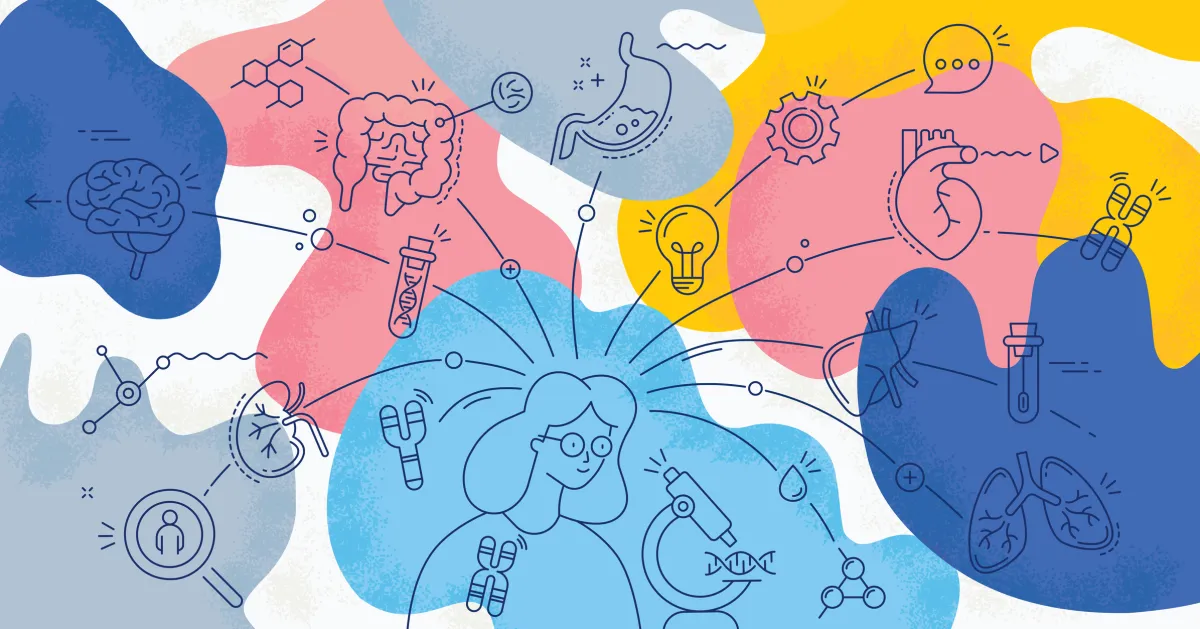
When you zoom in far enough, the immune system begins to look less like a set of parts and more like a conversation. Cells signal to one another. They cluster, separate, adapt, and behave differently depending on where they live in the body, the tissues they inhabit, and the signals they receive from their neighbors. What looks simple from a distance, at close range, becomes an intricate web of relationships.
For scientists trying to understand disease, especially in fields like transplantation, autoimmunity, and cancer, that complexity has always been challenging and held promise.
For Zicheng Wang, PhD, Associate Research Scientist at Columbia specializing in the integration of computational biology, the central question is deceptively simple: “Can we decode immune behavior computationally, and can we use that to improve clinical decisions?”
Dr. Wang is part of a growing group of researchers working at the intersection of computational biology, immunology, and translational medicine. Rather than studying immune cells in isolation, they are trying to understand the patterns that emerge when millions of cells interact—and are using computational tools, including machine learning, to interpret those patterns.
The idea is not to replace biology with artificial intelligence. If anything, the goal is the opposite. “The biological question comes first,” Wang explains. “AI is just a tool.”
What the field is trying to do, in essence, is teach machines to read the immune system the way scientists read genomes, by identifying patterns, relationships, and signals that would otherwise remain hidden in enormous amounts of data. “The genome is like a book,” Wang says. “We are trying to read it.”
If researchers can understand how immune cells recognize threats, organize themselves in tissues, and respond to disease, they may eventually be able to predict outcomes that today remain uncertain, like whether a transplanted organ will be rejected or how a patient’s immune system will respond to therapy. Work that could be life-changing in the most literal sense.
To approach that problem, Wang organizes his research around three levels of investigation, moving from the smallest molecular interactions to the clinical realities of patient care.
State of the Union: Liver Transplantation Today
Teaching Machines to Read the Immune System
At its most basic level, the immune system depends on recognition. T cells patrol the body looking for danger, using receptors on their surface to detect fragments of viruses, cancer cells, or other foreign molecules. Each T cell carries a unique receptor, created through a process that generates an enormous variety of possible sequences.
Understanding how those receptors recognize their targets has long been one of the central challenges in immunology, and Wang’s work approaches the problem computationally. His team develops models that attempt to predict when a T-cell receptor (TCR) will bind to a particular antigen—in the absolute simplest terms, essentially trying to determine whether a specific immune cell will recognize a specific threat.
The approach borrows tools from modern machine learning. Some models treat molecular structures as graphs, with atoms represented as nodes and bonds as edges. Others use architectures similar to those that power large language models like ChatGPT. The goal is similar to teaching a computer how language works, but instead, the models are learning the patterns that govern immune recognition.
In other words, they are beginning to map the language immune cells use to recognize the world around them. “We want to understand the grammar behind the T-cell receptor sequence,” Wang says. “Not only care about one specific TCR enriched in one particular disease, but the underlying rules that determine how they recognize antigens.”
This shift from studying individual examples to building general models mirrors a broader transformation happening across computational biology. Researchers are increasingly aiming to develop foundation models that capture the basic logic of biological systems, rather than building tools for one disease at a time. “Once those foundational models exist, they can be adapted to many different questions, from autoimmune disease to transplantation,” Wang explains. “For each particular transplant, we fine-tune the foundational model on top of that.”
Why Tissue Matters
But immune recognition is only part of the story. Immune cells don’t exist in a vacuum; they live within tissues, and like all beings, their environment shapes how they behave.
A T cell in the bloodstream may act very differently from a T cell embedded in lung tissue or the lining of the gut. Even when the cells share the same basic identity, their functions can diverge dramatically depending on where they reside. “The same T-cell type behaves completely differently in different tissues,” Wang explains. “Skin, lung, gut, each environment changes how those cells operate.”
Seen this way, the immune system begins to look less like a static defense system and more like a network of relationships, constantly adapting to its surroundings. “We cannot just analyze one sample,” Wang says. “We need to analyze the correlations between them.”
Understanding those differences requires technology that can examine cells individually and in context. Over the past decade, techniques like single-cell sequencing have transformed the way researchers study immune biology. Instead of looking at bulk tissue samples, scientists can now analyze thousands, or even millions, of individual cells, identifying their gene expression patterns and mapping how they interact with their neighbors.
The extraordinary level of diversity that has since been revealed is breathtaking. Even within a single category of immune cell, subtle variations in gene expression can signal different functions, developmental stages, or responses to disease.
For computational scientists like Wang, this data offers much opportunity and abundant challenge. The datasets are massive, but within them lie clues about how immune systems organize themselves—and how those patterns might predict clinical outcomes.
The Stealth Innovations of Modern Surgical Care
From Biology to the Clinic
At Columbia’s Center for Translational Immunology, Wang collaborates with the work of Megan Sykes, MD, Director and eminent researcher at the forefront of xenotransplantation and tissue graft tolerance, as well as guiding teams who study autoimmune disease and other immune-driven conditions. They share a common goal: to connect molecular patterns to clinical outcomes.
Researchers want to understand why some transplanted organs are accepted by the immune system while others are rejected, or why two patients with the same diagnosis can experience dramatically different disease courses. Wang explains that part of the answer lies in immune heterogeneity.
Even when patients appear similar clinically, their immune systems may be operating through entirely different biological mechanisms. “Two patients with the same diagnosis can have completely different immune processes driving it,” Wang says.
Computational models can help identify those hidden differences, offering a more precise picture of what is happening inside the immune system. Over time, that information could guide more personalized approaches to treatment, matching therapies to the biological realities of each patient rather than relying solely on broad diagnostic categories.
The Limits of What We Can See
One of the biggest challenges involves the gap between what scientists can measure easily and what is actually happening in the body. Blood samples are relatively simple to collect and analyze, which makes them a common source of data in immunology research. But blood only captures part of the immune system’s activity.
Many critical immune interactions take place within tissues themselves—inside organs, lymph nodes, or sites of inflammation. Cells that live permanently within tissues, sometimes called tissue-resident immune cells, may never appear in circulation at all. “Blood and tissue are quite different,” Wang says. “What we see in the blood does not reflect what is happening in the tissue.”
When a body starts to reject a transplant, the most definitive information still comes from biopsies of the transplanted tissue. And researchers hope that computational analysis of blood data may one day reduce the need for those procedures, but the challenge is significant. Scientists must first understand how signals in the blood relate to complex immune activity inside tissues.
Another key difficulty involves scale. Many immunology studies rely on relatively small patient groups, which makes it difficult to distinguish meaningful biological signals from statistical noise. “Right now, most of the data we collect is just a snapshot,” Wang says. “We do not have the ground truth.” Expanding datasets and integrating information across studies will be essential for building reliable predictive models.
Xenotransplantation, a Quest to Solve the Pediatric Donor Heart Crisis
In an era when artificial intelligence is often surrounded by hype, Wang takes a refreshingly pragmatic view of its role in biomedical research. “AI is powerful, but it is only as useful as the questions it is asked to solve,” he says. “We use AI as a tool—the biological question comes first.”
Sometimes that means applying existing algorithms to biological data, and other times it requires adapting techniques from adjacent fields or developing entirely new computational methods. In this new “AI era,” it can be easy to get lost in the technological novelty of it all, but the goal here is real understanding. “Intellectual honesty about limitations is what separates productive research from hype,” Wang says.
A Glimpse Into the Future
Wang believes the convergence of computational methods, large-scale biological measurement, and clinical data will fundamentally change how scientists study the immune system.
Within the next five years, he expects computational immune profiling to become increasingly integrated into clinical research and, eventually, clinical care. Over the long horizon, the possibilities become even more ambitious. Researchers are beginning to imagine the creation of digital twins, computational models that represent an individual patient’s immune system.
Built from a combination of molecular data, clinical history, and ongoing monitoring, these models could simulate how a patient might respond to treatments, infections, or organ transplantation. Instead of comparing patients to broad control groups, physicians might one day compare you to a personalized computational baseline.
“It would be like having a benchmark for each person,” Wang says. “Using that digital twin, you could predict what happens if a patient receives a higher drug dose or an organ from a different HLA [human leukocyte antigen] match.”
The concept remains largely theoretical for now, but the idea captures the direction the field is heading. As the ability to measure biology improves and computational models grow more sophisticated, the immune system may become less mysterious with each greater complexity revealed, because we are finally learning how to interpret the signals within it.
For Wang, the work always returns to the questions that started it all: Can immune behavior be decoded? And what new possibilities may come from it? If the immune system is in conversation, computational immunology may finally give scientists the ability to listen and grow relationships with the biology that lives inside us, each of us.
Related:
- Why People Donate a Kidney: Inside the Choice to Give
- Aiwu Ruth He, MD, PhD: Bridging the Lab and the Clinic to Transform Liver Cancer Care
- One Gift, Three Futures: Inside the 15-Hour Dance of the First Living-Donor Domino Split-Liver Transplant in Adults