

By Craig Smith, MD
Article first published on Dr. Smith's Substack, Long Incision.
What do abortion, assisted dying, organ allocation for transplant, genital cutting, body integrity identity disorder, and treatments for gender dysphoria have in common? Disagreement, discomfort, ambiguity, and cultural conflict. In each example, conscience can be invoked to justify providing or opposing medical care. And what is conscience? Among many definitions, consider the one provided by Dictionary.com: “…the inner sense of what is right or wrong in one’s conduct or motives, impelling one toward right action.” I judge it best for capturing the “inner” of right or wrong; for including both conduct and motives; but most importantly for concise emphasis on the link to action—”right action.”
And there you have it—the crux, the bleeding, beating heart of it—who defines “right,” and for whom? Dov Fox explores those complex dilemmas in his new book, The Conscience of Care. Fox is a Professor of Law, and the director and founder of the Center for Health Law Policy and Bioethics at the University of California San Diego. On the slim chance that some reader might enter the fray unarmed, Fox adds the breast-baring subtitle Navigating Health in the Culture Wars, and a central image on the dust jacket in which a blue band-aid x’s out a red one.
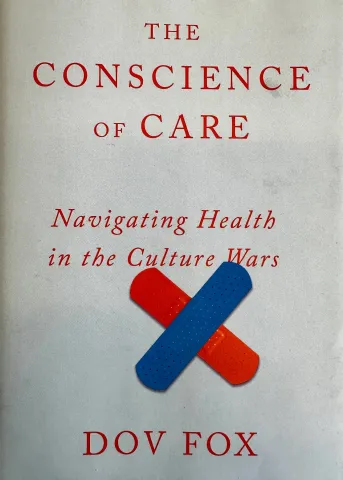
I am not an expert in law, bioethics, or reproductive medicine, but I was seduced by Fox’s insight that conscientious refusers and conscientious providers are treated very differently under existing law:
“…doctors and nurses who deny treatment on conscience grounds are categorically shielded from having violated the civil laws of medical malpractice and informed consent and even criminal bans on patient endangerment and abandonment. Refusers routinely get blanket immunity, while providers are never spared the heavy fines, license suspensions, or prison sentences that attach to their just as conscientious offenses.”
Readers puzzled by the difference between categorical shielding and blanket immunity, who wonder if the second sentence is simply a paraphrase of the first, have a point to which I will return later. More immediately, note “just as conscientious.” Applying conscience to care only requires congruence between actions and an individual’s inner sense of right and wrong. Whether conscience-driven actions are judged Right or Wrong out in the polis isn’t supposed to matter—yet it does, and political judgment is why abortion refusers face minimal consequence while providers can lose everything. That legal disparity—that flagrant injustice?—is what compelled Fox to write this book, and propelled me to read it.
Rather than offer a dictionary definition of his own, Fox devotes an excellent first chapter to “The Meaning of Conscience in Medicine.” We learn that conscience is individualistic, that it can have secular/philosophical and religious foundations, and that its best-known origin story—conscientious objection to war—is an imperfect fit to the medical example. Why? Primarily because doctors were not conscripted, they elected to enter a profession that offers privilege, prestige and financial security in exchange for certain obligations, and those obligations can include providing access to treatment.
No one should be surprised that abortion gets the most ink, by far. This is a post-Dobbs book; index cites for Roe and Dobbs combined overwhelm other comparably discrete topics. Fox makes the imbalance in potential consequences for exercising conscience to refuse or provide abortion very clear and compelling. If you believe, as I do, that abortion is an important option for women, then you will agree that a doctor who refuses even marginal involvement when the indication for abortion is compelling should not go unpunished when a doctor in Texas providing abortion faces life in prison.
Fine—you and I agree on that—but when care is influenced by conscience, motives and conduct are determined by individuals. The heartfelt convictions on abortion we share with Fox have no greater standing than theirs, no matter how much we wish to pass judgment. Thundering away at the disparity in consequence between abortion refusal and provision doesn’t make the conscience-driven motives on either side right or wrong. Nor does it make the opposing conducts (refusal or provision) categorically right or wrong. I think Fox is acknowledging those cautions when he aptly points out that “Tidy divisions seduce us with the promise to transform moral muddle into pure and perfect justice.” Yet I couldn’t help wondering if this book would have been written if the existing legal disparity was the reverse—abortion providers get blanket immunity while refusers do life in Leavenworth.
Fox addresses our natural desire for consistency by thoughtfully exploring other subtopics for which his abortion template (refusal = bad, provision = good) might not so neatly apply. For example, he is very careful to acknowledge the ambiguity and evolving state of evidence surrounding the radioactive topic of treatments for gender dysphoria.
Fox also discusses treatment of “body integrity identity disorder” with enviable objectivity. I confess I was unaware that any surgeon, in good “conscience,” would amputate a normal extremity to treat a delusion. Fox, more generously, grants that atrocity space on the spectrum of controversial operations applied “at the border of disease and desire,” a spectrum that already has “top surgery,” genital cutting, and leg-lengthening at one end, with many cosmetic procedures at the other.
More than simply parading before us a carnival sideshow of clashing practices and beliefs, or wallowing in the moral muddle, Fox also does the much harder work of conceiving remedies. The twenty-six-page chapter containing his recommendations I will very superficially summarize by saying they revolve around proof of reasonableness, proper and complete consent processes, referral mandates, and fair allocation of health care resources. No doubt his proposals would mitigate some of the legislative extremism we grapple with today.
Even when I became impatient with Fox’s dense legalistic analysis, my desire to understand the complexities behind inequitable consequence drove me through The Conscience of Care. I strongly encourage others to take up the challenge. But be prepared for a workout! At least for me, much of it required multiple re-readings for comprehension. Regarding the repetitiveness I foreshadowed earlier, I will enter two more paragraphs into evidence:
“How might that entrenched cacophony enable us to peacefully navigate our intractable disagreements? Why be confident that we could live together with people whose visions of what’s good and bad we regard as irrational, dangerous, or evil? Can we coexist nonviolently in ways that don’t trivialize, suppress, or persecute our differences of opinion by deliberately ignoring them or seeking empty solace in contrived harmony and false unity?”
Three insightful, high-calorie sentences—might one suffice?
Consider a lengthy paragraph focused on the important issue of omission versus commission:
“…acting versus not acting….[two sentences]…“Forcing the refuser’s hand is worse than tying the provider’s, even if both would violate the respective conscience of each….[four sentences]….Broadly, the celebration of personal liberty heightens the burden to make some people do certain things, compared with keeping others from being allowed to step in, when both the forced doings and prevented allowings would equally violate their moral convictions.”
Fox had me at “acting versus not acting.” Were nine elaborate paraphrases necessary? Was the point to wedge in orthodox progressive abhorrence of personal liberty, and keep the culture wars alive? Or was the intent to mimic the use of repetition as a time-honored rhetorical device in the pulpit? Indeed, the tone often feels like preaching to the progressive choir.
Fox’s profligate use of gendered pronouns almost broke me, even if it’s only harmless virtue-signaling. Granted, a sprinkling of pronouns can make writing more breezy, colloquial, and digestible, but almost any sentence can be written without one. Did Fox load a shotgun with shells containing gender pronouns—in equal numbers, one hopes—then blast away at the text? Among googolplex examples: “Conscience isn’t a call to arms. It’s about doing the right thing for the individual herself.” Very important point succinctly made, but “herself” adds exactly nothing—I don’t think Fox believes that conscience is somehow gendered. In the next example, astute observations verily echo off the chamber walls:
“The moral beliefs that comprise a person’s conscience are typically traceable to a shared ideology, collective affiliation, or common commitment that informs her considered judgment about what it means to do good or live well. What makes her claim of conscience worth respecting isn’t just that she deeply believes certain things to be right or wrong, in a subjective sense, all on her own. More important still is the extent to which conscience tends to serve objectively deserving purposes, especially ones that connect someone to the world around her.”
Appending that fifth personal pronoun to the last sentence not only adds nothing, it undermines the critical, impersonal point—it is precisely those “objectively deserving purposes” that connect people to the world and release us from the her/his prison of conscience-driven conduct.
Throughout I wish someone had applied clippers, brush, and comb to the tangled language and maddening repetition. It appears there were editors involved—from the Harvard University Press, no less. Perhaps they never imagined that anyone from outside the bubble would plunge into such an enveloping bubble-bath. Maybe it was enough to establish Fox as an authority citable by more translucent authors. The lack of editorial rigor matters because readers who won’t plow through this book will have missed an opportunity. Whoever you are, if you persevere, I promise Fox will make you think deeply about profound and confounding concepts.
Finally, I salute Fox for saying “America’s toleration of resistance to institutional or governmental orthodoxy gives cause for hope.” Bravo, hosanna, hallelujah! If only—but in our elite educational institutions how has resistance to orthodoxy fared in recent years? I briefly mentioned the central image on the dust jacket. Culture Wars peeks out over an “X” formed by a blue band-aid stuck across a red one. Did some red person with bad conscience stick their band-aid over the wound of Roe/Dobbs? Then did someone with good conscience happen along and slap on their noble blue band-aid? I prefer to think that the symbolism of a band-aid as an inadequate half-measure was not lost on the artist (Abby Weintraub), who’s reminding readers that even an infinite stack of red and blue half-measures will never heal our wounds.
Related:
- The Culture Consult: Dr. Craig Smith on What He’s Been Reading Lately
- State of the Union: The Stealth Innovations of Modern Surgical Care
- Lessons Learned: Surgeon Craig Smith Reflects on Career in the OR