
Key Takeaways:
Liver cancer care today is multidisciplinary by design, with a single coordinated team and a unified plan from day one.
Transplant is no longer a last resort; for carefully selected patients, it can treat both cancer and underlying liver disease at the same time.
From robotic resection to living donor transplant, innovation is expanding access, shortening recovery, and redefining what’s possible.
Liver cancer rarely follows a straight line. Often, it arrives alongside chronic liver disease or cirrhosis. By the time they reach a surgical program, many patients have already spent years navigating appointments, scans, biopsies, and treatment decisions. Care doesn’t move through a single specialty either; it exists at the intersection of many—from oncology, hepatology, interventional radiology, to transplant. And that complexity is only growing.
“The care of liver cancer has become increasingly complicated,” says Jason Hawksworth, MD, Surgical Director of Adult Liver Transplantation and Chief of Hepatobiliary Surgery. “Most patients need more than one type of therapy. That might include chemotherapy or immunotherapy. For liver tumors, interventional radiology often does local regional therapy to treat tumors and keep them from growing or spreading, and reduce tumor burden.”
For the majority, surgery eventually becomes part of the picture. “Most primary liver cancers are surgical diseases,” Dr. Hawksworth explains. “The goal is to remove the tumor, or transplant a patient in some cases, especially when there’s underlying chronic liver disease. Transplant can treat the cancer and the liver disease at the same time, and it lowers the risk of recurrence.”
That dual impact—addressing both cancer and cirrhosis—is one of the reasons transplant now plays such a central role in liver cancer care. It’s also why treating this disease well requires far more than a single specialist.
One visit, one team, and one plan
The Liver Cancer Program doesn’t have patients moving from office to office, retelling their story over and over again. From their very first visit, they’re seen together by a coordinated group that includes transplant hepatology, surgical and medical oncology, and interventional radiology.
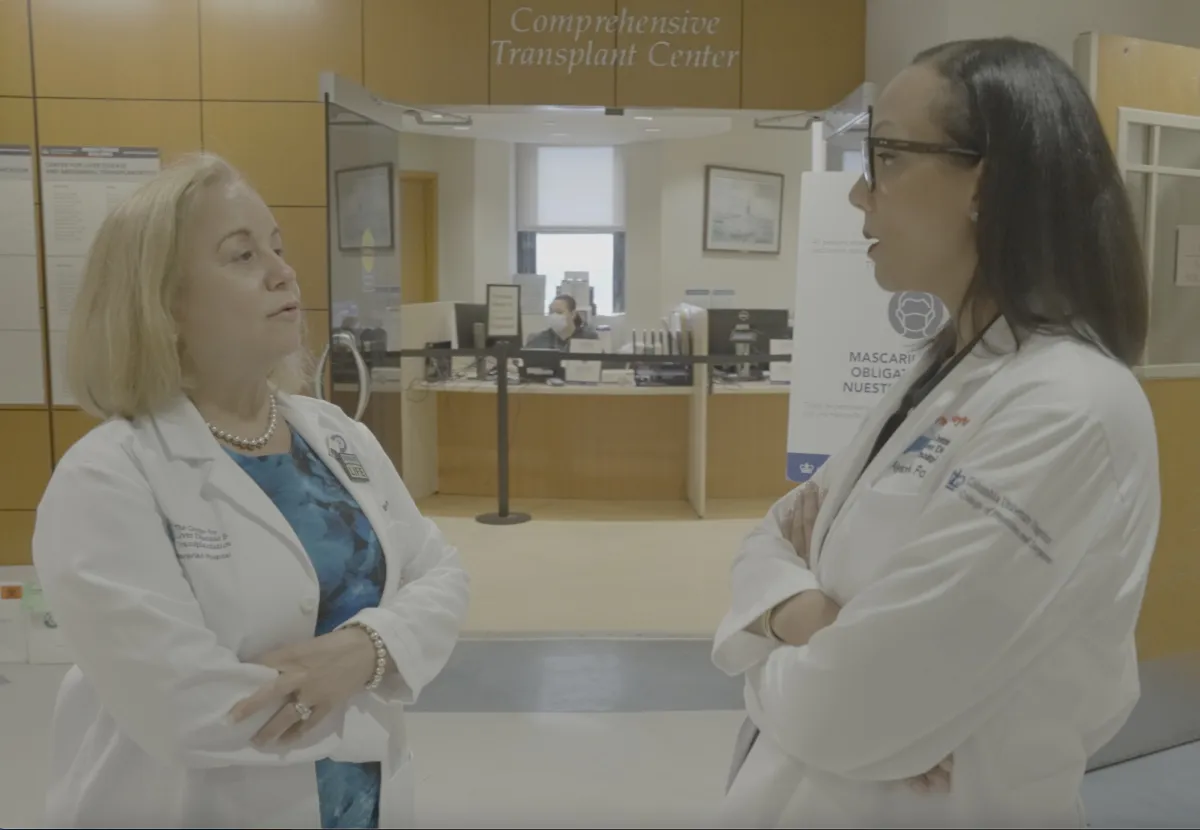
“They see everybody,” says Meghan Phipps, MD, a transplant hepatologist who specializes in liver cancer. “We review their case ahead of time, then come in as a group and meet them together. The goal is for patients to leave that first visit with a unified plan.”
That structure isn’t just logistical; it changes how care unfolds. Patients treated in multidisciplinary liver cancer programs are more likely to receive treatment, have better survival, and report a better overall care experience than those seen in fragmented settings.
“It improves communication between providers,” Dr. Phipps says. “But just as importantly, it improves communication with patients. They don’t have to tell their story five different times. They leave understanding what’s happening. We’re making decisions together, in real time.”
Dr. Hawksworth breaks it down even further. “We pre-screen the chart, decide who the patient needs to see, and schedule everyone simultaneously. We review imaging together before clinic,” he says. “Patients walk out the door the same day with a treatment plan.”
For people who have already spent months, sometimes years, moving through the medical system, that can be truly transformative. “I can’t even make it to my own primary care appointment,” Dr. Hawksworth says. “I can’t imagine having to go to five different doctors in five different buildings on different days.”
Read a conversation with Director of Hepatobiliary Cancers, Aiwu Ruth He, MD, PhD, on Bridging the Lab and the Clinic to Transform Liver Cancer Care
Transplant oncology: not new, but newly refined
Dr. Phipps works in a field that’s now called transplant oncology: liver transplantation for cancer indications. While it feels like a modern frontier, the idea itself actually goes back decades.
“If you look at the history of liver transplantation, the first handful of transplants in the 1960s were actually done for oncologic indications, including cancer that had spread to the liver,” she explains. “So, transplant for cancer isn’t new. What’s changed is how careful we’ve become with patient selection and protocols.”
Historically, transplant was primarily offered for hepatocellular carcinoma (HCC) and cholangiocarcinoma or bile duct cancer, both of which originate in the liver. But over the past several years, that scope has expanded.
In 2019, International consensus guidelines formally defined transplant oncology. Since then, national review boards and updated protocols have broadened eligibility for carefully selected patients, including some with colorectal cancer that has metastasized to the liver. “We’re certainly one of the centers pushing those boundaries,” Dr. Phipps says.
Randomized trials now show a significant survival advantage for select patients with colorectal liver metastases who undergo transplant compared to chemotherapy alone—fundamentally changing how this population is approached. Still, transplant is never an automatic decision. “There are strict criteria,” she says. “We follow detailed protocols for each indication to make sure patients have the best possible outcomes.”
Even when a cure isn’t guaranteed, transplant can offer meaningful benefit. “We talk about transplant with the goal of cure,” Dr. Phipps explains. “But in some cancers, recurrence risk is high. There’s still a clear survival benefit. Part of our job is helping patients understand both the hope and the reality.”
In some cases, patients arrive too advanced for transplant. But even then, that doesn’t mean the conversation ends. “We always try to turn a case that might not be appropriate for transplant at presentation into a transplant case,” Dr. Hawksworth says.
That can involve immunotherapy, chemotherapy, or interventional radiology techniques designed to shrink tumors and ‘downstage’ disease. “Our goal is always to get patients to the best therapy possible,” he says. “Ideally, a cure. If not a cure, at least more time with a good quality of life. We won’t offer a transplant if it’s not going to help the patient. Every tumor is different, and we approach it that way.”
Robotics, recovery, and redefining surgery
Beyond transplant, Dr. Hawksworth also performs the majority of his liver resections robotically, even for complex cancer cases. “At this point, basically 95 percent of my hepatectomies are robotic,” he says. “There’s almost no scenario where I won’t offer robotic surgery.”
The difference in recovery is dramatic. “An open hepatectomy is a huge physiologic insult,” he explains. “We spread the ribs. It’s a big incision. Robotic hepatectomy turns that into outpatient incisions.” Patients often go home within one to two days, sometimes sooner.
For people who still need chemotherapy or radiation afterward, that matters. “They can start adjuvant therapy sooner and tolerate it better,” Dr. Hawksworth says.
Changing the Future of Living Liver Donation: A Conversation about Columbia’s All-Robotic Approach
Living donation and access to care
For many transplant oncology patients—especially those with colorectal liver metastases—access to deceased donor organs is limited. “Living donor liver transplant is often the only reliable pathway,” Dr. Hawksworth says. “And people do their research, they know we offer things other programs don’t.”
“Some patients come in with potential donors already lined up,” Dr. Phipps adds. “Others have never heard that living donation is even possible. Education really is a part of care, no matter what.” Most patients who arrive at the liver tumor clinic are deep into their medical journey, and many self-refer after reading studies, joining patient groups, connecting with others who’ve undergone transplant, or seeking second and third opinions.
“They’re incredibly knowledgeable,” Dr. Phipps says. “They ask hard questions. And that’s always encouraged. There’s no such thing as a bad question. This is objectively overwhelming. Transplant is life-altering. But we’re with you every step of the way.”
She often connects patients with others who’ve been through similar transplants, especially for rare indications. “Other patients are always an incredible resource,” Dr. Phipps adds.
For both Dr. Hawksworth and Dr. Phipps, the heart of the program is the entire group’s dedicated coordination. “This is a team sport,” Dr. Phipps says. “Transplant is complicated. Add cancer on top of that, and it gets even more complicated. Being able to meet everyone, hear every perspective, and see how we work together—that makes all the difference.”
The Liver Cancer Program has expanded to Columbia/NewYork-Presbyterian’s new Westchester location, The One. Patients can now access multidisciplinary liver cancer care closer to home in White Plains, NY. To learn more about our programs and services or make an appointment at any of our locations, call (877) LIVER MD/ (877) 548-3763 or fill out our online request form.
Related:
- Bots for Tots: The First Program in the U.S. for Robotic Liver Surgery in Children
- State of the Union: Liver Transplantation Today
- A Look Inside the 24-hour Dance of a Split-Domino Heart Transplant