
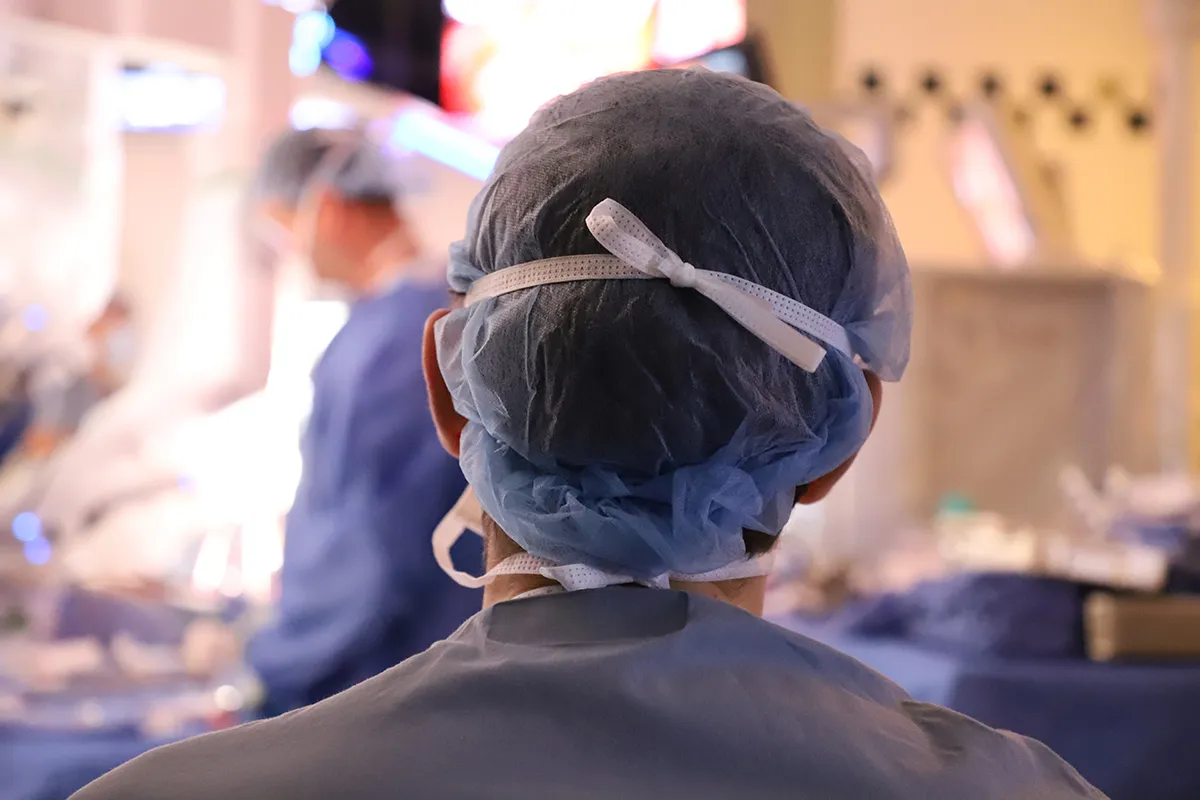
An Afternoon With The Busiest Robotic Heart Surgeon in America
I’m standing in the lobby of a hospital, a few minutes early for my rendezvous with Arnar Geirsson, MD, Chief of the Division of Cardiac Surgery at NewYork-Presbyterian/Columbia University Irving Medical Center (NYP/CUIMC)
“The lobby” is a sprawling space, so as a meeting spot, it’s easy to imagine missing someone, even if you’re actively looking for them. I spend a minute or two scanning back and forth when I get a text: “Sorry. The meeting I was presenting at kept dragging on. Coming down now.”
The text disrupts the admittedly unfounded early assumptions I’d formed of Dr. Geirsson. In my defense, I think I can be forgiven for assuming his success would be predicated on a VERY strict use of time.
Dr. Geirsson is BUSY. To describe him as prolific would be an understatement; the gap between Geirsson and a typical cardiac surgeon is comically large. The latest data from the Society of Thoracic Surgeons (STS) shows the median yearly case volume for robotic mitral valve surgeries is five.
Geirsson averages around 100.
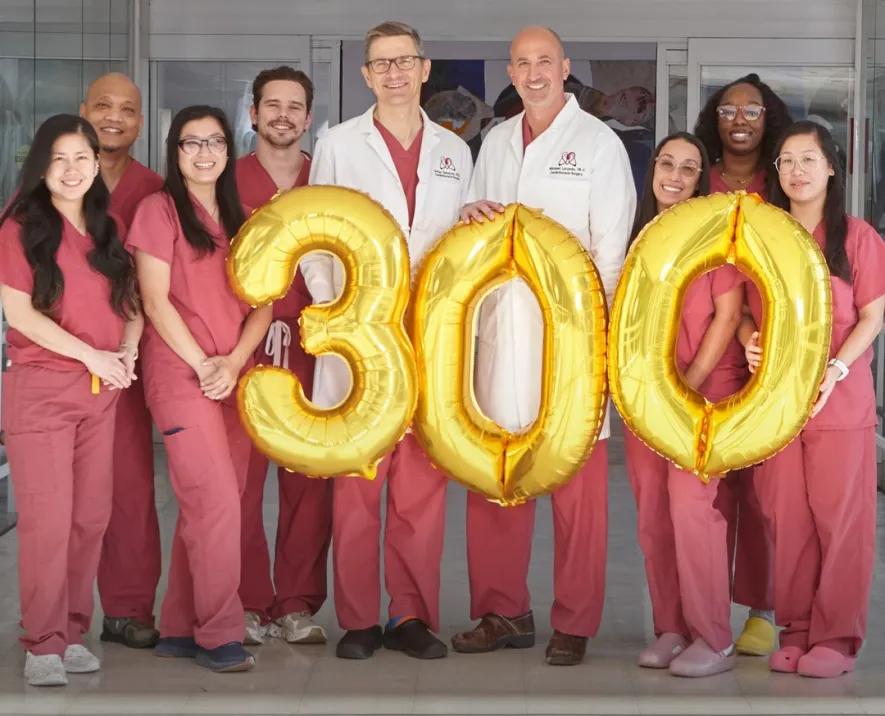
And his outcomes are equally impressive, especially when considering his volume. Since Dr. Geirsson’s arrival at Columbia, he performed most of the more than 300 robotic mitral valve repairs while maintaining a 99% success rate. His colleague, Paul Kurlansky, MD, director of the Center for Innovation and Outcomes Research at Columbia, describes Dr. Geirsson’s sustained excellence as “phenomenological.”
Which is why I’m here: to get a better understanding of how Dr. Geirsson can perform so many surgeries while maintaining truly extraordinary outcomes. And after hearing about Dr. Geirsson for years now, I am genuinely curious about this meeting. As someone who has interviewed dozens of surgeons, it’s hard not to notice certain archetypes in the field, especially for exceptional performers. Type A, curt, efficient. Very focused on time. Not inclined towards hand-holding. Gruff.
But by all accounts, Dr. Geirsson is nothing like that. In speaking with other surgeons and faculty about Dr. Geirsson, I’ve consistently heard words like “kind,” “warm,” “incredibly nice.” “A great guy” comes up a lot. But speak about him long enough, and there’s one comment that everyone eventually offers without prompting: “If I ever need mitral valve surgery, he’s the one I’d want to do it.”
Not long after his text, I see Dr. Geirsson approaching as he calls out my name, a broad smile on his face. He’s tall and thin, no sign of the hunched posture so common in seasoned surgeons. I wonder briefly if robotic surgery spares its practitioners that fate, but dismiss it immediately. After all, they spend their time hunched over a console, don’t they?
We shake hands and re-introduce ourselves; we’ve only previously met through Zoom calls. His demeanor is relaxed and friendly, not a hint of annoyance or urgency. If my request to shadow him while he goes about a typical day is an inconvenience, he shows no sign of it. We head off to get our scrubs.
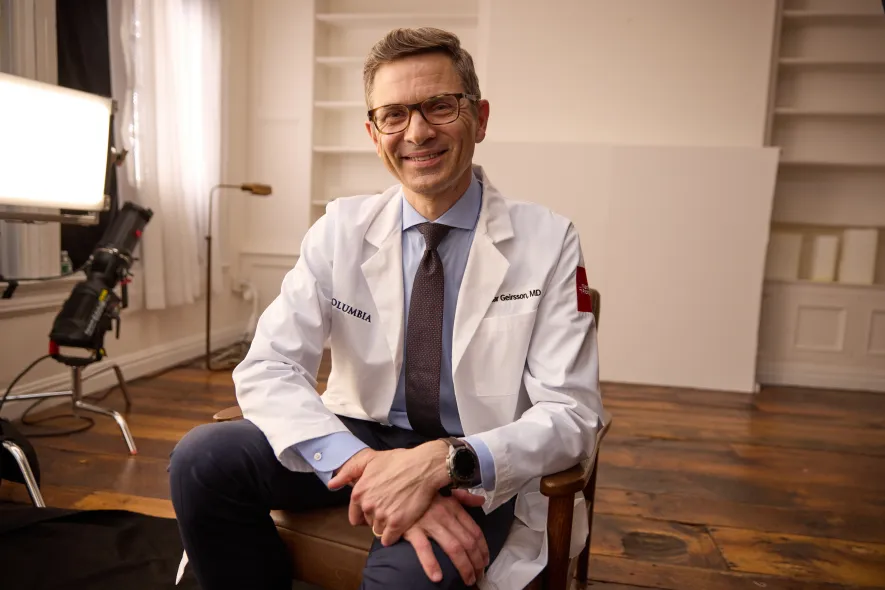
Dr. Geirsson joined Columbia in 2023, coming over from Yale, where he served as the Chief of the Division of Cardiac Surgery. During his time in New Haven, Dr. Geirsson developed his expertise with minimally invasive cardiac surgery, specializing in robotic mitral valve repair and aortic valve repair.
He was responsible for a number of firsts at Yale New Haven Hospital (YNHH), including their first minimally invasive right thoracotomy mitral valve surgery and YNHH’s first robotic mitral valve surgery. He established Yale’s highly-successful Robotic Mitral Valve Repair Program, which served as a blueprint for the program he would develop at Columbia/NYP.
He is also the Co-Director of both the Columbia Surgical Cardiovascular Research Institute (CVRI) and the Mitral & Tricuspid Center, part of the Columbia Structural Heart and Valve Center. His research encompasses basic and clinical science, centering on mitral valve prolapse and valve disease.
After grabbing our scrubs from the vending machine, we head up to his office area to change, taking the stairs. He jokingly apologizes for being delayed, placing the blame directly on the meeting topic. “We started talking about marketing,” with a laugh and an eye roll.
After donning my scrubs in the bathroom (and finding a way to tie off the oversized pants enough to not embarrass myself), I find Dr. Geirsson waiting and ready. We head off — again, at a comfortable pace.
We take the stairs to go visit some of his patients recovering from surgery. “The hour between when the patient is prepped and when we start surgery is a weird “free” hour. Sometimes it’s meetings, sometimes I can use it to visit patients. I like to let patients know who I am and make sure they know I’m going to take great care of them.”
I stand back a bit as Dr. Geirsson visits three patients in recovery. The first feels good and wants to head home sooner; they have people to take care of. Dr. Geirsson gently reminds her that she still needs care and attention, too. But they reach a compromise, and a revised plan is now in place.
His second patient is more complicated; complex disease, a kidney transplant. He patiently explains what to expect, asks in detail how she’s doing, reassures her that her recovery is on track.
The third is experiencing some swelling; Dr. Geirsson discusses how they’ll manage it in detail.
All three interactions are unrushed, and only end when the patient seems satisfied with his answers.
As we head to the OR, I ask him about his schedule. “I operate four days a week, once or twice a day.” I mentioned to him that he seemed very present while talking with his patients, despite the fact that he’s on his way to operate. He seems surprised, and with a smile and a shrug, says, “It’s important to me that I see them, and they see me.”
We talk a bit about today’s surgery, a mitral valve replacement. He explains a bit about his overall workload and the importance of everyone involved being prepared, including the patient. “I do a fair number of low-risk surgeries, and those are very predictable. But I also do many high risk ones, and for those, I take the time to talk to the patients, make sure they understand.”
We talk about the challenges involved with high-risk cases, where comorbidities make things less predictable. “But in cardiac surgery, what’s really tough is when something goes wrong during a low-risk procedure. Which can happen, even if you do everything correctly. It’s easy to keep asking yourself what you could have done differently. But all you can do is prepare.”
Robotic surgery is a bit of a misnomer; there is no autonomous, thinking robot involved, at least not in the science fiction meaning of the word. Instead, a robotic surgery platform consists of a number of articulating arms that end in various surgical instruments, all operated remotely by the surgeon sitting at a console a few feet away from the patient. A hi-res 3D camera inserted into the surgery site guides the procedure, offering real-time feedback and a scaled-down perspective.
While it might seem counterintuitive to separate the surgeon from the surgery, a robotic approach offers a number of benefits for the patient. The controls and design of the robot allow for an extraordinary level of precision. The robotic arms don’t tire or move unless directed to, so fatigue or tremors aren’t a factor. And because it uses much smaller incisions, it avoids the large sternotomy associated with traditional open heart surgery.
That carries forward benefits like reduced pain during recovery, a lower risk of complications like infection, requires shorter hospital stays, and leads to much faster recovery times.
While manipulating robotic arms at a console is vastly different from the world of open heart surgery, both types of surgery still rely heavily on a team of specialists to keep everything on track. It is still very much dependent on people performing their roles at every step of the procedure.
We reach the OR, where Dr. Geirsson introduces me to members of his team standing in the hallway, before stepping away for a moment. The team members are discussing the new surgical robot: a more advanced piece of equipment that provides haptic feedback for an even greater sense of awareness. I’m getting the impression this is a big deal.
The lead PA and co-director of the Robotic Cardiac Program, Michael LaLonde, MHA, PA-C, mentions that people were wondering if Dr. Geirsson would prefer to be the first person to use the new robot. I recall Dr. Geirsson’s many firsts at Yale, so it doesn’t seem unreasonable.
But the question brings about genuine laughter. “I’m pretty sure that Dr. Geirsson will be fine going second or third. He’s not going to care about that.” The rest of the team agrees, dismissing the idea completely. It’s another reminder that Dr. Geirsson doesn’t fit the stereotype of the prima donna surgeon, even if people outside his team expects him to.
I speak more with Michael “Mike” LaLonde and learn that he came over from Yale with Dr. Geirsson, where the two worked together since 2007. I ask him how Dr. Geirsson has changed over the years. “He’s still the same guy. Incredibly easy to work with.” Dr. Geirsson returns and joins the conversation, talking about how long he and Mike have worked together.
I ask Dr. Geirsson about the new robot, and a big smile lights up his face. “Cardiac surgery is very specialized. But in the end, it’s my hands, I can feel what I’m doing. Feedback is how I know I’m succeeding.
But what about the current robot? “No feedback. You just develop a feel for it.”
It’s time for the surgery to begin. I’m ushered into a place where I’m not in the way, and I watch a team of 10 set the stage. Surgeon, resident, anesthesiologists (fellow and attending), three nurses (including one scrub nurse), PA, perfusionist, a surgical technician. There are other people in the OR, but they aren’t part of the flow; like me, they’re just observing for now.
I am told under no circumstances am I to touch anything blue; blue means sterile. This much I know, but I’m grateful for the reminder.
I watch as the team finishes the last steps before the procedure begins. The patient is resting on the table, already under anaesthesia. There’s constant activity surrounding them, but nothing frantic. Orderly chaos. Less like a pit crew and more like a very slow dance, one person smoothly replacing another as different steps are completed.
I am on the far side of the patient, so I miss seeing them make the five small incisions they’ll use for the surgery: four 8mm incisions and one 2cm in the right chest wall.
Someone must have noticed me craning my neck like an eager fan trying to catch a glimpse of a celebrity. I’m moved closer and asked to sit quietly in a chair directly facing one of a few high definition monitors.
I am now sitting under the speaker, and the music is a bit of a surprise. I expected Bach, or maybe Gershwin. At the very least, I expected Dr. Geirsson to choose the music. Instead, I’m bopping in my seat to Ke$ha, Charlie xcx, Fergie, 50 Cent… LMFAO? There’s definitely something unusual about watching mitral valve surgery with “apple-bottom jeans, boots with the fur…” rocking out in the background. (It’s a playlist on one of the nurse’s phones.)
After perfusion, the robot is wheeled over to the patient. It’s large and futuristic looking, but C3-PO, it is not. If you want a better Star Wars comparison, I'm reminded of the FX-7 medical droid on Hoth from the Empire Strikes Back. (Yes, I recognize that is a deep-cut, but the resemblance is strong enough to make me wonder if it wasn’t an inspiration.)
Once all the ports are in place, Dr. Geirsson gives the word, and the lights go out. I wasn’t expecting that, so it takes me a moment to adjust. Not complete darkness; more like what you’d expect at naptime in nursery school. Or a play about to begin.
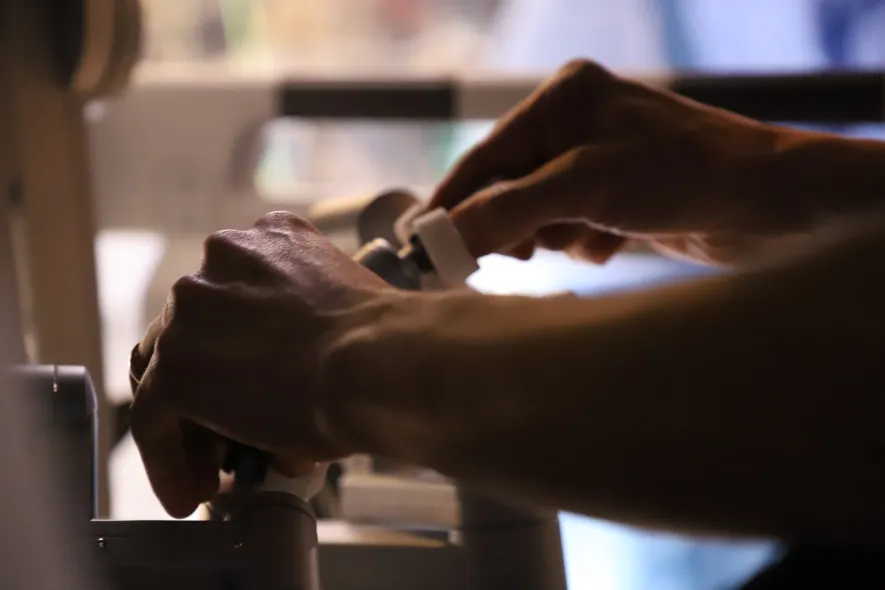
And so it begins. I look over at Dr. Geirsson, who is sitting at the dual console with his surgical resident, Sameer Singh, MD. They can take turns throughout the surgery as part of Dr. Singh’s training; they see the same view, and Dr. Geirsson, as the lead surgeon, can take over at any time.
But that’s not much of a view from my perspective, so I turn my attention to the screen in front of me. I'm excited to see the valve implanted; I’ve watched traditional valve replacement surgeries on video, but never a robotic one. And being in the OR makes for a very different experience.
I watch as the “hands” from the robot pulls excess tissue away from the valve, while another cleanly cuts it away. I see it pulled away out of view, and catch Mike out of the corner of my eye withdrawing a long tool that holds the material, which he places in a nearby metal surgical bowl. That process repeats a few times.
Watching the procedure is hypnotic, which may be why it takes me a few minutes to realize I’m watching a mitral valve repair, not a replacement. I suppose plans have changed.
It also takes a surprisingly long time to realize that I’m hearing sounds echoing around the room, and I’m having trouble placing them. The monitor has no audio feed, but the noises seem to line up with the activity: a snip here, a vacuuming sound there.
I then process that I’m not hearing a feed at all… I’m hearing the actual sounds of the surgery. The largest port is acting like a megaphone of sorts, and I’m hearing the snips of the robot. For some reason, I find this completely fascinating; it changes my entire perception of what I’m witnessing.
Watching the screen, it’s easy to feel like you’re viewing something in the abstract; it’s not unlike watching the procedure on youtube (something I’ve done many times as a writer for Columbia.) But to hear the surgery, to be able to place those sounds as emanating from the patient just a few feet from me, shifts me back to the reality of what I’m watching.
It’s the first time I’ve come up against some genuine cognitive dissonance about the entire experience. You can understand things on a surface level; I’ve been writing about robotic surgery for years, including this very robotic program. But in person, there is something surreal about watching something as significant as a heart valve being repaired, with the surgical team surrounding and managing the patient, while the surgeon sits off somewhere in your peripheral vision. It feels a bit like a magic trick.
And just like that, the lights come back on, and everyone shifts to new places. The robotic portion of the surgery is complete, and the team works to finish up. After a few minutes, Dr. Geirsson is out of his surgical garb and leading me out of the OR.
I’m still getting my head around what I just watched when Dr. Geirsson say to me, “Would you like to see how it’s done the other way?” And almost before I can answer, he leads me to another OR. After getting permission, he leads me to the far side of an operating table; my view is obstructed by a cloth wall. “Take a look,’ says Dr. Geirsson, with a huge smile on his face. It is the most excited I’ve seen him act all day.
So I do. I move closer and look over the barrier… and I am looking at a human heart. A heart in a person’s chest. It’s clean of any blood, and I am struck by how many colors it has. It looks almost more like a model designed to clearly demarcate the different regions than an actual heart.
For everyone in the room, this is just another Monday. But for me, it’s a truly beautiful and fascinating sight. I’ve been writing about cardiology for years, but actually looking at a living heart is an exhilarating and humbling experience. It brings into focus why surgeons do this. It is a difficult and demanding occupation, with more than its share of stress and sadness. But looking down at the patient, it’s hard not to feel at least a little jealous.
Not wanting to be in the way, I withdraw and thank everyone for the opportunity. But I could have stared at that heart for hours.
We discuss how things went as we walk. I ask about the switch from replacement to repair. He tells me he made the decision once he saw the state of the valve. I ask if this is an easy decision to make on the fly. “This was a little bit more complex than most, but obviously there are clear benefits if you can effectively repair the valve over replacing it. With repair, there's no prosthetic, nothing that will need replacing. If you get good initial results, you should expect good long-term results.”
I ask about how skill with the robot differs from traditional surgery. “Cardiac surgery is a highly technical operation. The outcome is highly dependent on how well you do the operation, and that comes down to how you use your hands to do it.”
“Of course, it's not just your hands; obviously much of it is in your mind. How you set it up. But what was always interesting to me, and the reason why I wanted to pursue this, I felt this kind of instant positive feedback about what you do. Positive and negative feedback. What you do and the stuff that you feel you can control, at least most of the time.”
We talk about his role as a teacher, and how he knows when someone has the skills to be a robotic surgeon. “I think most of the time with the trainees, you can see early on if they’ve got what we call ‘the hands,’ you know? And, just as important, are they able to connect the hand and the brain together? You can see very early on which people are gifted surgeons.”
“And you can also obviously see people that are not going to get there anywhere. We try to intervene on that. Most people can be trained, but those people are kind of in between.”
I mention that I came here to understand how he can perform so many more operations than his peers, and offer that it seems like his personality plays a huge part. His temperament, which I would not describe as the typical “heart surgeon.” Does he see a connection?
He shrugs and laughs. “I still love what I do. I think you want to try to approach it a little bit… happy, basically. I think it's also very important for the team. And nothing happens without the team.
There's different ways of motivating people, but I like the way I try to motivate people: Just try to be positive about things, making things easy. So it's true, I'm probably not the typical cardiac surgeon.
Was he always this way?
Dr. Geirsson pauses and considers. “I used to be very quiet, settled down. You know, people used to call me the ice man. Calm and collected. I just did stuff, no noise. But that's changed. And I think that's how I like it. I mean, I still like waking up every morning knowing that I'm going to be doing cardiac surgery. When you do something you like, it's not a problem.”
I realize that we’ve been heading to a waiting room, and it dawns on me that we’re meeting the family of the patient he just operated on. He lets them know that the surgery went great, and that he was able to perform a repair instead of a replacement, explaining that it’s a better option for the patient long-term.
I’ve never been on this side of telling someone such great news. Witnessing their relief was a beautiful moment. My father recently had emergency heart surgery, so I’m aware once again of that feeling of gratitude. It’s strange to be on the other side, even by proxy.
A family member excitedly shakes Dr. Geirsson’s hand, and seeing me standing next to him in scrubs, assumes I’ve played a part and shakes my hand with equal enthusiasm. Not wanting to steal any valor, I mumble something about just being Dr. Geirsson’s guest, and step back to let them celebrate.
But I can see how wonderful it must be to deliver that news, 100 times a year.
Related
- Standards of Care Are Changing, and Robotic Surgery Is an Anchor of Advancement
- Guide to Robotic Heart Surgery: What to Expect
- Dr. AI: Is Robotic Heart Surgery Better than Open Heart Surgery for Mitral Valve Repair?