
What happens when a surgeon turns his eye from the operating room to crime fiction? In "Stone Hearts", Craig R. Smith, MD, cardiac surgeon and former Chair of the Department of Surgery, builds a medical caper rooted in transplant, intrigue, and the peculiar moral weather that hovers above and beyond the hospital.
Follow along each Friday as we release the novel one chapter at a time. You can also see more on Dr. Smith's Substack, Long Incision.
In Chapter Five, Dr. Bessette led his team of four on a Learjet flight to Montreal to retrieve a heart donor. During the flight assorted biographical details of each passenger were revealed, and the donor operation was described to Gus, an inexperienced medical student. Dr. Besssette made telephone contact with his brother Jean, living in Montreal, at the end of Chapter Two. Chapter Five takes place almost one year prior to the publicity interview begun in Chapter Four that now resumes in Chapter Six.
Late April, 1990
Lindsay returned to the conference room to find her team still fully on break. They rose as one and moved towards the setup. Ron Ellsworth was leaning on a windowsill studying the Hudson River. Noticing Lindsay’s approach he turned and said “Same river, I know, but it’s a bit bigger down here!”
This time the subject seemed much more comfortable taking his seat under the lights across from the inquisitor.
“Are you ready for more, Mr. Ellsworth? In this session I’ll be going places that may not seem directly related to your transplant.”
“Sounds…interesting. Like going where?”
“When I was talking to Marcia about interviewing you, at the end she said ‘Ask him about Woodstock.’ I can’t pass that up! I wanted to start there, if it’s okay.”
“No kidding! Marcia remembered that? So do I…so do I.” Ellsworth hesitated, with pursed lips, looking serious. “Sure, why not.”
“Okay, roll tape. We’re live again, Mr. Ellsworth. So you were there? At Woodstock? You must have been rather young.”
“Young…yeah, I was fourteen. Young for being there without parents. As everyone in my family reminded me at least a hundred times. I was the family free spirit back then. My grandmother said I must’ve sold my soul to the devil—her way of saying what did I expect, being friendly with those hippies who were taking over Sugar Hill? My hair was real long for a farm kid. I wore tie-dyed tee-shirts, some silly-ass beads, other hippie stuff. I was way too young for the draft, or to enlist, and besides, I kept thinking about Henry. He was finally out of the VA. You won’t believe this—Henry survived the entire siege of Khe Sanh in 1968 without a scratch. I was thirteen then. I bragged about my big brother the Marine hero at school. Then he steps on a VC booby trap when he’s way behind the lines on R&R, down near Da Nang. Damn near lost his legs. Lost other things, though…he can’t have children….”
“That’s awful, I’m so sorry!”
“Yeah, thanks, that still bothers me. He was so depressed for the first couple years, we thought we’d lose him. That he might off himself. I start thinking maybe a lot of the VC were like old farm families from Sugar Hill—just down on their luck, getting pushed around by money and politics. Anyway, a great surgeon saved Henry’s legs. Seven, maybe eight years ago he married Delia. She was divorced, living in Poughkeepsie, two nice kids of her own. Henry’s being a great step-dad. Clinton, my oldest brother, was also a Marine, in Nam, real early in the war. Woodstock summer he was a rookie New York State trooper, outside Syracuse. I mention that stuff to give you a sense where my head was at.”
“Exactly, I get it, just keep going!”
“This huge music festival that seemed sure to land somewhere in Sullivan County was all anyone was talking about that summer. I told my parents I had to go. They said ‘you will do no such thing!’ I stockpiled my cash, put some basics in Clinton’s old USMC backpack, left a note on the kitchen table so they wouldn’t worry too much, and took off at 3 AM on Friday, while everyone was asleep.”
“That would be August 15th, right?”
“Well, yeah, whatever that Friday was. I walked north a couple hours to the outskirts of Chester, where I crossed under 17 on Kings Highway. The sun was just up. I couldn’t believe how heavy the westbound traffic was—it was like thunder in the underpass, and I was still a good fifty miles away. About a mile on I walked up the entry ramp to the westbound lanes. I’m about to put my thumb out, and I see this red Buick sedan on the shoulder a hundred yards up ahead, trunk open, four people standing around staring inside. I walk up to check it out. They have a flat right rear, and don’t seem to know what to do about it. It’s three guys and a really pretty girl, tall, thin, long brown hair.”
“’Flat tire?’ I say to the group. The pretty girl looks around at the others. No one replies, so she takes charge. ‘Good eye, young man! We seem to be meditating on what to do about it.’”
“So I say, ‘If you have a jack and a spare, you can just change it.’ I got three blank looks from the boys. The girl steps forward and says ‘I’m Ginny. It seems I’m representing the intellectuals. Do you think you can do that?’ Swear to God, Lindsay, that’s how she talked. You didn’t want to be on the wrong side of her tongue! Then she said if I was hitching to Woodstock, that’s where they were going, and I could join them!”
“I changed the tire and the guys were piling back in the car twenty minutes later. Ginny got a good look at my backpack when I threw it in the trunk. She says ‘So you’re a Marine? How old are you?’ Eighteen, I say, trying to make my voice stay low. She says ‘Yeah, and I’m Joan Baez! Come on, Ronnie, why didn’t you go for something half-way believable, like sixteen?’ I knew she had me made, and I’d coughed up the truth before she could close the trunk. I fell madly in love with Ginny for saying nothing to the rest of the car about me being only fourteen, for the whole trip. Our little secret.”
“I rode the backseat hump, between Ginny and a guy, who turned out to be her boyfriend from some Yale graduate school. It came up that his draft number was something like twenty. He was working that deferment! Next month Ginny would be a senior at Vassar, over in Poughkeepsie. In the front seat were two other Yale guys. Just my crowd. I said to myself ‘You better keep your mouth shut!’”
“We were making maybe 2-3 miles an hour on 17. The sun was going down when we crept into Monticello, still ten miles from Bethel. The driver, a guy named Marty, pissed and moaned as if he was the only guy who couldn’t drive right up to the stage. We parked with like ten thousand other people in a church parking lot, and started walking. I just booked it down the highway. Had to wait for the Yale boys to catch up all the time, and I think I got some respect for that. Ginny kept up, right off my shoulder. She got me to talk about me and my family.”
“It was long after dark when we reached the site. Ginny directed me and her buddies to an old school bus, all painted up in bright colors, owned by friends of hers in a thing they called the Bread and Circus Commune. It was parked in a half-circle of other weird buses on the edge of the main crowd, great location. It started raining, pretty hard. We dumped our gear and huddled in the bus debating when to head for the stage. It got crowded with people coming back from close-up who said one of the bands refused to play in the rain. We waited until the rain drumming on the roof lightened up a bit and headed over. Everyone seemed to assume I was a regular part of Ginny’s little gang, and I just went with that.”
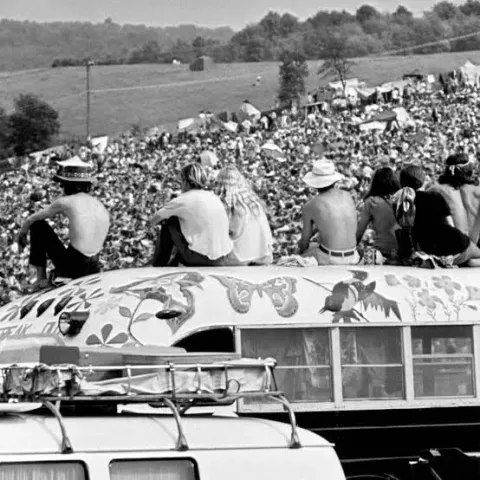
“We got soaked pretty quick but got close just in time to hear Joan Baez come on, at around 3 AM. She starts up with a song I’d never heard about a guy I never heard of—Joe Hill. Something about it got right into me, and I’ve never forgotten the best line: ‘Says I “But Joe, you’re ten years dead” / “I never died” says he / “I never died” says he.’ I thought of Joe Hill again last May. Obvious why, I guess. Sorry, kind of corny. April found my old cassette and I played it for Marcia. That’s how she got me talking about Woodstock.”
“I’m glad she did! So you’re finally there, and it’s already Saturday?”
“Saturday was a blur. Slept a couple hours. Shared hundreds of joints that were getting passed around. All kinds of drugs were just everywhere. About noon, Ginny went off looking for food, and Marty the driver asked me if I wanted an acid tab. Why not? I figured. An hour later I saw why not. I must have looked pretty wild, because the minute Ginny saw me she asked if I’d taken something. Marty was sitting there laughing his ass off about how high I was tripping—‘kid’s trippin’ balls!’ he says. Ginny spins around and smacks him in the ear so hard it knocks him off balance. She let him have it, yelling at him, but through her whole tirade about how reckless he was she still didn’t let on I was so young.”
“I was watching them go at it from what felt like some prison planet a billion miles away. Everything they said was echoing through my head real, real slow. The visions and colors and crazy shit were, I don’t know, what can you say? When Ginny smacked him I could see her arm moving for like a century or two, why didn’t that skinny dope get out of the way? I could see why they called acid a ‘trip.’ I was everywhere and I was nowhere. Ginny stayed with me, made sure I drank water, guided me around through the worst of the craziness. It wasn’t until Janis Joplin was up there on stage, around 2 or 3 AM, that I could tell I was getting normal again. Because I remember thinking you’d have to be completely wasted on acid to enjoy her mic-sucking bullshit. The speedy part of the trip was still coming and going until the sun came up, about when The Who went off stage. Then we all totally crashed and decided sleep was more important than Jefferson Airplane. Ginny said they were overrated Bay-area burnouts anyway.”
“You didn’t like White Rabbit? I thought everybody did!”
“Now you remind me, Ginny mentioned White Rabbit. She said the caterpillar must have given me the mushroom that made me older, instead of taller, and just like Alice I’d be able to go back.”
“After a couple hours of sleep we went off looking for food. Ginny made me stand in line forever at the pay phones to call my parents. They were pissed, then scared, then they thanked me for calling and made me promise to come home the first chance I had. I promised to try.”
Lindsay said “I don’t have any teenagers yet, but I sympathize with your parents!”
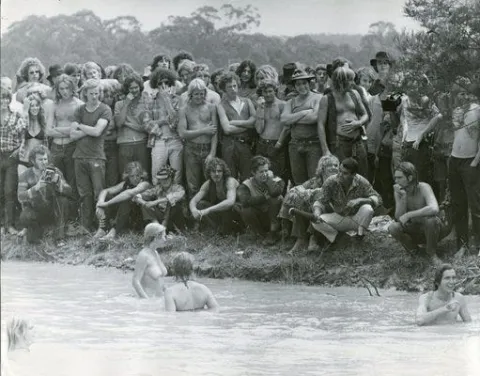
“I’ll have teens of my own pretty soon, God willing, and I know now what I put my parents through! Anyway, next Ginny and her boyfriend wanted to swim in Filippini’s pond, just down the hill behind the stage, where so many people were skinny dipping. They invited me along. They stripped and jumped right in. Ginny naked was the most beautiful thing I’d ever seen! Boyfriend was one of those noodle-y hippy types who can’t change a tire.”
Lindsay jumped in: “Lucky for you, I guess. That was your ride!”
“That’s true! And I wouldn’t have had Ginny looking out for me. Back to the pond, I wasn’t about to go naked in front of all those girls and hung back on the bank. Out of the corner of my eye I see this little girl, naked, maybe not even two years old. She’s toddled right up to the edge. It wasn’t like there was a beach or anything, it was a typical upstate farm pond, you know, tufty hummocks of grass lining the edge a foot or two above the water. The little thing steps right off, there’s barely a splash, and she disappears. I look around real quick, no one seems to be reacting. I leap right in where she went under. The water was halfway up to my waist, real muddy, and I can’t see her. I was thrashing around with my arms for what felt like a hopeless amount of time when something bumped my leg. I grab for it, and it’s her!”
“The funny thing was, when I pulled her out she was blue and looked…dead. All of a sudden she coughs and cries for a second, then she looks around like nothing ever happened. She was just all wet, and curious about my face. Later I heard babies that age know instinctively not to breathe underwater. I bet you can picture this next part—for me to go splashing into the pond and come up carrying a baby drew a crowd. Then through the middle of that crowd comes this half-naked skeleton-woman—skin and bones, her face all hard creases over her skull, but she had these out-of-scale tube-y tits sticking off her ribs, like zucchinis—I’m sorry, Lindsay, I mean breasts!”
“That’s okay, Mr. Ellsworth, I want you to tell your story your way! For what it’s worth, I bet most women would prefer ‘tits’ to ‘zucchinis.’”
“Well, still, I’m sorry, I’m just an old farm boy, I don’t want to offend anyone. Anyway, here comes skinny-woman, and in one arm she’s holding an infant she must have been breast-feeding. And she’s beating on me with one bony fist to give her baby back, what am I doing with her baby, and all that, she almost knocked us back into the pond. I’m thinking I’m not giving this little girl to that crazy woman, and held the baby close and tight, which only made Mom more crazy, and both babies started in crying. Then this superfreak-Jesus guy wearing a loincloth comes through the crowd, calms bone-woman down, gives her a kiss, and says to me, ‘Thanks, man, I got this!’ I gave him the baby, and she stopped crying. This whole time I didn’t speak a word. I was afraid the stress would make my voice crack high and give me away.”
“Ginny and Boyfriend were still out splashing around and missed the whole thing. When I told them what happened Boyfriend thought I was bullshitting until I pointed out the happy family, sitting there in the mud by the edge of the pond, and Jesus gives me a friendly little wave. Ginny says ‘That’s amazing! You may have saved a life!’”
“Lindsay, I haven’t thought about that scene at the pond for years! But you know what I think, today? I think that pretty little girl could have ended up as an organ donor, if I’d been a little slower—but not too slow…or a little less lucky—but not too unlucky. Maybe all her parts would have found better homes. Lived better lives, with better parents. What did that hopeful, smiling little thing have to look forward to? Then I say to myself, ‘Listen to you, what do you know—who are you, God? What gives you the right?’ See what’s happened to me, carrying around my ‘gift of life?’ I don’t even know if they were doing transplants back then!”
“Mr. Ellsworth, do you need a break?”
‘Maybe so…I guess so…sorry, Lindsay, I get embarrassed the way little things set me off.”
“Not a problem at all! Stop recording. Everyone, let’s take about twenty minutes, then we’ll finish up.”
More Stone Hearts chapters:
Next...
Chapter 8: The Brothers Bessette
Related:
- A Conversation with Dr. Craig Smith on His Novel “Stone Hearts,” the Art of Writing, and the Surgeon’s Imagination
- Lessons Learned: Surgeon Craig Smith Reflects on Career in the OR
- Nobility in Small Things: A Look Back at The Leadership of Craig Smith, MD