

What happens when a surgeon turns his eye from the operating room to crime fiction? In "Stone Hearts", Craig R. Smith, MD, cardiac surgeon and former Chair of the Department of Surgery, builds a medical caper rooted in transplant, intrigue, and the peculiar moral weather that hovers above and beyond the hospital.
Follow along each Friday as we release the novel one chapter at a time. You can also see more on Dr. Smith's Substack, Long Incision.
Late April, 1990
The scrape of chair legs on the hard floor silenced the set as Lindsay repositioned herself, crossed her ankles, and flipped her notes open to a fresh page. “All good, folks?” She noticed that the light from the west-facing windows was sliding an interesting new shadow across her subject’s face.
“Ready to go, Mr. Ellsworth? You were talking about the little girl at the pond. Remember, we’re done whenever you say we’re done.”
“I appreciate that, but let’s do this. Once you start turning over the compost, best to keep forking! So, back to the pond—after I told Ginny about the little girl, Joe Cocker was just coming on stage, up the little hill behind us. We worked our way around to the front again. Cocker is doing this totally deranged, air-guitar version of some Beatle song and right behind him everyone could see this huge thunderstorm bearing down on the field. The announcer starts yelling at people to ‘move away from the towers!’ A bunch of the hippies around us are talking seriously about how fascists seeded the clouds to ruin the festival. The announcer starts up a chant, a couple hundred thousand people shouting ‘no rain!, no rain!’ What, they think they can conscientiously object to a thunderstorm? Well, it blew right over the stage and cut loose, thunder and lightning and wind—a classic August water-cracker. Everyone got drenched again, up to our ankles in mud.”
“If you know anything about upstate weather you know this thing’s going to blow through and the sun will come out. Just as it hit, I thought—you may not believe this, but I remember it like it was yesterday—I thought I am the storm of storms, I will wash the world clean! Right away I caught myself—is that the acid, come back on me? That scared me shitless! Of course, the storm blew on through and that’s exactly what happened—the world was clean and clear and cool again. I thought, who are these people? They can’t take thirty minutes of summer rain? I need to be out of here! Turns out Ginny’s crew was starting to feel the same way. Later I was sorry I missed Hendrix, if only to see if he was really that great.”
“So you missed his Star-Spangled Banner!”
“I heard the recordings later; I don’t think I missed much in the way of music, although I guess it would have been cool to say I’d been there. And by then the field was such a filthy, muddy mess—blankets and clothes and rotting food all over the place!”
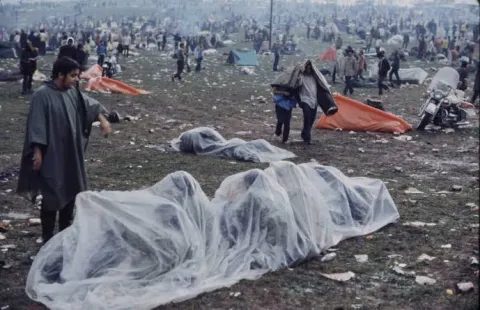
“Back at the bus we packed up and started off on the ten-mile hike back to Monticello. For the first few miles, through the old graveyard and past that big lake just north of the road, the Yale guys were riffing on how amazing and peaceful the whole scene had been. Everyone feeding each other, sharing everything, the dawn of peace and love for all time, stuff like that. I knew I was the dumb little farm kid, but I finally had to say something to those phonies, for the first time all weekend—so I say ‘If they were so peaceful and loving and all, why were they shouting ‘Pigs!’ at the Army helicopters? The guys who volunteered to fly out people who were hurt?’ Well, those three didn’t know whether to laugh and keep walking, or stop and piss on me.”
“The Yale boys were just getting warmed up to piss on me when Ginny jumped in. She asked how long they thought ‘that utopia’ would last—another day? A week? She called it ‘i-ronic’ for people who’d sucked up to the Hog Farmers for brown rice to be calling anyone pigs. She said the Hog Farm’s heart was in the right place but they’d been sucked into a power trip— sure, they were helping with bad trips and bad drugs, but they were also playing at law and order and controlling the food supply. ‘The Hog Farm already had hundreds of Boxers,’ she said, ‘how long would it be before they picked out their Snowballs?’ I didn’t know what she was talking about—Snowball and Boxer and all—but it looked like the Yale boys did. They left me alone. And after a couple more hills they were so worn out they didn’t even talk to each other.”
“The red Buick was right where we left it, by the church in Monticello. It took forever driving back, worse than coming in. Sometime Monday morning we got to the off ramp in Chester and Marty pulled over to drop me off, about opposite where they’d picked me up. Ginny wouldn’t let me out. She told Marty ‘We’re driving Ronnie home!’ in that voice she could use to shut everyone down. She was right that it wasn’t that far out of the way to New Haven, but I could have walked the 3-4 miles, like I was expecting to do.”
“We pulled up to my house. Ginny got out and walked up to the front door with me, one hand on my shoulder. If she was shocked by how run down our house was, she didn’t let on. My mother was crying and she and Dad were hugging me but they didn’t know what to do with Ginny. She waited for things to settle down, then introduced herself, and said ‘I just wanted to be sure Ronnie got home. But mostly, I want to be sure you know what a fine young man he is. He even saved a little girl who would have drowned. I’m grateful I met him, and you should be very proud.’”
“Lindsay, I’m sure I don’t have that quite right but she laid it on pretty thick, it was stuff like that. My Dad was getting that misty look he gets sometimes. My mother invited everyone in for something to eat. Ginny thanked her real kindly but said no. I was glad she did. I wanted to share them with Ginny, but not with those other guys. And that was that! I never saw Ginny again.”
“I’m sorry, Lindsay, that’s a lot more than I told Marcia, I guess I got carried away.”
“Don’t apologize! I want you carried away. That’s how the soul enters the story. If there’s more, I want to hear it someday. I’m wondering, though. Sitting here today, or back then, how does the whole thing stack up? Was it everything you dreamed it would be, or a waste of time, or something in between? Are you glad you went?”
“Mr. Ellsworth, I’m sorry about that rambling mixture of comments and questions, I probably wasn’t clear—”
“No, I got you, but I had to think hard about that. It’s like you’re expecting me to say it was some total takedown of peace-love and the whole hippie thing. I get why you’d hear it that way. Sure, maybe I wanted it to be perfect—the kid’s only fourteen, never been anywhere, didn’t know what to expect. Why did I even want to go? Maybe because some of the Sugar Hill hippies were going, and they’d been nice to me. Treated me like I knew things they didn’t know. But on that Friday, when I started walking to 17, there was nothing in the world I wanted more than to be part of that scene up in Bethel, come what may. I’m not smart enough to know what the real story is, or was, or should have been. It was what it was, and I was there!”
“I don’t think you give yourself enough credit for insight. I’ve had you talking for so long, we should wrap it up.” Lindsay flipped quickly through a few pages of her notes. “Is there anything you think people should know about the whole awesome business of organ donation? What it’s like to benefit from such an unselfish gift?”
For the first time, Ron Ellsworth looked annoyed. “What’s it like? Come on, Lindsay, the gift was life! There’s none bigger, and no thanks that’s enough!”
“I’m so sorry, Mr. Ellsworth! You’re right, that was a stupid, lazy question right out of a can. The enormity of what you’ve been through must be hard to manage sometimes.”
He quickly calmed down. “Yeah, sometimes, but I guess that’s part of why you’re doing this. To answer your question I’ll try to tell this story…but it’s hard, I can’t always get through it.”
“Please, take your time.”
“You see, I met my donor’s family, maybe six months ago.”
“No! Really? I didn’t know that was possible.”
“Well, you’re right that it’s almost not allowed.”
“You’ve just reminded me of something from this morning. You said ‘that poor kid’s heart’ and I thought how much does he know?”
“Meeting them was fallout from the attention Dr. Bessette got for his trip to Montreal to get my new heart. All that ruckus happened after I was home. My donor’s family followed the news. There were just enough details leaked for them to figure out who I was. And his Dad was a Mountie, who pulled some strings. They called my house on the phone one day, right out of the blue. I called Marcia, she kicked it around her team, and they set up a meeting, down at Denomination. Very secret, no news coverage, no one was supposed to know. I learned a lot about him, and his family.”
“We can stop if this is too upsetting. You look pained.”
“No, it’s okay, but I won’t get through this if I don’t cut it short. We met. They were such nice people! Mother, Father, and his 14-year-old brother…same age as me at Woodstock, now that I think of it. I have to say, they seemed so happy to meet me! And talk to Alice, and meet the kids. How would I feel, I wondered. Are they saints?”
“His Dad looked like he hadn’t stopped crying since it happened. He said ‘We have some pictures, if you’d like to see them.’ Marcia twisted in her chair enough to catch my eye and frowned and shook her head real hard and tight, so they wouldn’t notice. I wished she’d prepared me for this possibility. So I said—completely winging it here…afraid to say too much and look like I didn’t mean it…or to say too little, like I didn’t appreciate it—I said ‘No thanks, that’s very nice of you, but I kind of see him all the time.’”
“His Dad was thinking about that, maybe a little hurt, when his Mom asked me for a special favor. She was so shy about it, I couldn’t imagine what she wanted. She asked to feel my pulse.”
“And I let her feel it, right here, on my wrist. She hung on for such a long time! She finally let go, and started crying, but she was still smiling. She said ‘I know you’ll take great care of him!’ The father and brother started in crying. Then we all hugged and said goodbye. The three of them walked out holding each other and left him with me. Sorry, Lindsay, that’s all I can do.”
Two days later the Director sat down next to Lindsay in front of a large screen in his office. She hit “play” on the VCR. They watched straight through, scribbling notes and timestamps, then rewound here and there, and took more notes.
They stood to walk around, stretch, and refill their coffee mugs. The Director said “Setting aside the Woodstock part, you have a real cute story for Denomination, and a compelling interview subject. I trust you to do all the editing for the client. Run the final edit by me, and by their people. Work with their graphics team on the print materials. Try to have most of it done in time for Mr. Ellsworth’s anniversary.”
The Director walked over to a whiteboard and stood facing it, without picking up a marker. “What do you think you’ve got here?” he said, not looking at Lindsay.
Lindsay didn’t answer immediately. “I think this could be big. It could be a fine profile-slash-documentary, handled right.”
The Director turned to face her, nodding his head slightly. “I agree. If we’re going to do that, we need to move on three fronts.” He picked up a blue marker, and drew up a list as he talked. “One is getting permission from the client to repurpose our shared material. That shouldn’t be hard, we can show how it’s another marketing win-win. I’ll handle that. Number two is permission from Mr. Ellsworth. You have a relationship with him now. What do you think?”
“I’m optimistic.”
“Okay, number three. How do we structure it, shape it, where do we aim it? I’m sorry we missed the 20th anniversary of Woodstock!”
“Me too, but the 25th is not so far off.” Lindsay tried to temper her excitement. “And it wouldn’t hurt to have more time to fill out the story. I can look at all the film that’s already out there from the festival, see how it lines up with his narrative. Maybe somebody caught our players somewhere. Track down the baby that almost drowned, and her family story. I bet enough people saw it happen that we might find third-party narrators. We need to find Ginny—a strong female character like her is a goldmine.”
“Ambitious! You’re hoping they’re all still alive. And that Ginny isn’t a lonely alcoholic librarian in Newburgh. Although I guess that’s still a story.”
“Sure, the longitudinal view is unpredictable, standing here today. But I’ve already found a yearbook for the Vassar class of 1970. One Jennifer and a Geneva with nicknames “Ginny”—I’m betting it’s Geneva Mayerson. Her photo is how I picture Ginny, and the other stuff sounds kind of like her. Ron might be able to ID her for me from the yearbook. If we get Ginny we might have the Yale guys. We already have Ron’s patriotic brothers and two ancient Hudson Valley farm families.”
“I love it! But whatever direction we go, we have some shaping to think about. Like Ginny’s Animal Farm discussion at the end. Cut it. Too Reagan/Bush.”
Lindsay sighed. “If you think so…whatever, Ronald Ellsworth will still be Ron Ellsworth, not Ronald someone else. And I want to run with this.”
“If you go for the 25th, there’s another variable to think about. Isn’t there some chance you will have lost your hook, your fulcrum?”
“I’m ahead of you there. I’ve been reading. 70% survival at 5 years.”
“So 30% against…keep in mind the little girl in the pond might have had similar odds. Lindsay, my dear, even if he gets cheated by fate, you still have a story. It’s just a different story. Get as much as you can upfront.”
“I’ve gotten to know him. I like him. I’d miss him.”
It was time to throw the mood switch. The Director turned back to his white board, picked up a new marker, and drew a giant red heart. “Go for it!”
Lindsay walked up next to The Director. “Those other complications that Denomination’s so worried about—if they blow up, this becomes huge.” She picked up her own marker and wrote “Bessette” in giant blue letters. “Remember you heard it here first!”
More Stone Hearts chapters:
Next...
Chapter 8: The Brothers Bessette
Related:
- A Conversation with Dr. Craig Smith on His Novel “Stone Hearts,” the Art of Writing, and the Surgeon’s Imagination
- Lessons Learned: Surgeon Craig Smith Reflects on Career in the OR
- Nobility in Small Things: A Look Back at The Leadership of Craig Smith, MD