
On Page Nav:
Guide to DIEP Flap Breast Reconstruction
On Page Nav:
DIEP flap breast reconstruction is an advanced surgical procedure used to rebuild a breast after mastectomy using the patient’s own tissue. The procedure transfers skin and fat from the lower abdomen to the chest while preserving the abdominal muscles.
DIEP stands for Deep Inferior Epigastric Perforator, the blood vessels that supply the transplanted tissue. Using highly specialized microsurgery, surgeons connect these vessels to those in the chest to restore blood flow to the reconstructed breast.
Because the reconstruction uses the patient’s natural tissue, the breast looks and feels more natural than implant-based reconstruction. The tissue also ages with the patient and does not require replacement in the future once it is healed – this is in contrast to implants, which are not lifetime devices.
Key Info
- DIEP flap reconstruction uses skin and fat from the lower abdomen to rebuild the breast.
- The procedure requires microsurgery to reconnect blood vessels.
- Results are long-lasting and use the patient’s own tissue.
What Is DIEP Flap Breast Reconstruction?
During the procedure, surgeons remove a section of skin and fat from the lower abdomen while carefully preserving the abdominal muscles. This tissue is referred to as a “free flap.”
The tissue is then transplanted to the chest and shaped into a new breast. Using a surgical microscope, surgeons reconnect tiny blood vessels from the flap to vessels in the chest to restore circulation.
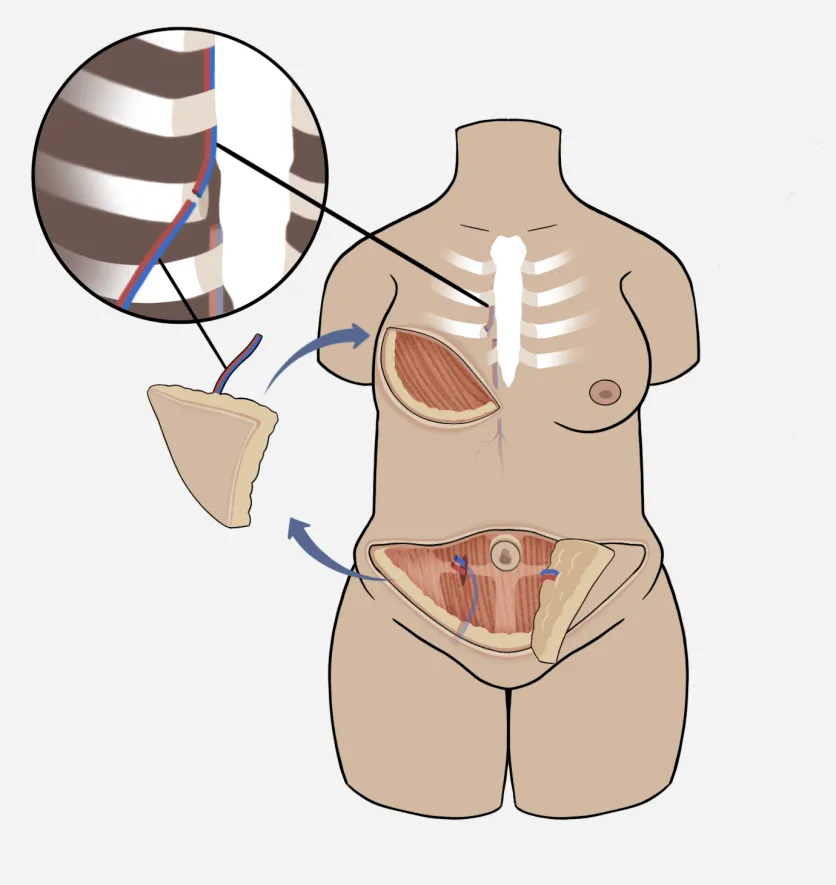
Exposure of the vessels in the chest often require removal of a small portion of rib cartilage.
Because the abdominal muscles are preserved, patients typically maintain most of their core strength and abdominal function.
On the outside, this procedure produces an effect similar to a tummy tuck, as the same area of excess abdominal tissue is removed.
When Is DIEP Flap Reconstruction Considered?
Breast reconstruction may be recommended after:
- Breast cancer mastectomy
- Preventive mastectomy for high-risk patients (such as BRCA mutation carriers)
- Removal of breast tissue due to cancer recurrence
Patients may choose reconstruction to restore body shape and symmetry after breast removal.
DIEP flap reconstruction is often considered when patients:
- Prefer reconstruction using their own tissue
- Want to avoid breast implants
- Have enough abdominal tissue for reconstruction
- Are candidates for microsurgical procedures (i.e., non-smokers, low risk of blood clots)
What Are the Benefits?
DIEP flap reconstruction offers several advantages:
- Uses natural tissue, resulting in a soft, natural-feeling breast
- Avoids implants and their potential complications
- Preserves abdominal muscles
- Lower long-term maintenance compared with implants
- Improved breast symmetry
- Long-lasting results
For many patients, this technique provides both breast reconstruction and abdominal contour improvement.
Who Is a Candidate for DIEP Flap Reconstruction?
You may be a candidate if you:
- Are undergoing or have undergone mastectomy
- Have sufficient lower abdominal tissue
- Are in good overall health
- Do not smoke or are willing to stop before surgery
- Are able to undergo a longer surgical procedure
Patients with certain medical conditions or insufficient abdominal tissue may require other reconstruction options. Other potential donor sites for donor tissues include the thighs, “love handles,” and back.
What Type of Anesthesia Is Used?
DIEP flap reconstruction is performed under general anesthesia, meaning the patient is asleep for the entire procedure.
How Is DIEP Flap Reconstruction Performed?
Typical steps include:
- The surgeon makes an incision in the lower abdomen.
- Skin and fat are carefully removed while preserving abdominal muscles.
- The deep inferior epigastric perforator blood vessels are identified.
- The flap (the skin and fat with its attached blood vessels) is removed from the body and is transferred to the chest.
- Using microsurgery, blood vessels from the flap are connected to chest vessels.
- The tissue is shaped into a natural breast contour.
- The abdominal incision is closed similarly to a tummy tuck.
The procedure usually takes 8-10 hours, depending on complexity and whether one or both breasts are reconstructed.
Will I Be Able to Keep My Nipple?
In some cases, the nipple can be preserved during the mastectomy (nipple-sparing). This requires the nipple to be healthy (i.e., not within or near the cancer) and appropriately positioned on the breast. The ideal patient for this has smaller, perkier breasts, but those with larger, droopier breasts may opt to undergo a breast reduction or lift several months before the mastectomy to optimize the survival of the nipples.
If the nipple has already been removed or cannot be preserved, options for nipple and areola reconstruction include:
- Local skin flaps
- Skin grafts
- Medical tattooing
Your surgeon will explain your options to help determine which one is right for you.
What Are the Risks?
As with any major surgery, potential risks include:
- Bleeding
- Infection
- Blood clots
- Flap failure (rare)
- Fat necrosis (small firm areas within the reconstructed breast)
- Delayed wound healing
- Abdominal weakness, bulging, or hernia
- Need for additional procedures or revisions
Microsurgical expertise helps reduce these risks.
What Is Recovery Like?
Recovery typically includes:
- Hospital stay of 2-3 days
- Monitoring of the transplanted tissue to ensure healthy blood flow
- Limited activity during the first few weeks
- Wearing abdominal support garments and bras
- Drain care (typically one drain per breast and two drains in the abdomen) to remove any fluid that collects in the surgical sites
- Gradual return to normal activities
Most patients resume many daily activities within 6 weeks.
Is DIEP Flap Surgery Painful?
Patients usually experience soreness in both the chest and abdomen after surgery. The abdomen is usually more uncomfortable than the breast because your core muscles are essential for moving around. Pain is typically managed with medications and improves during the first weeks of recovery.
How Long Does Full Recovery Take?
- Initial recovery: 6-8 weeks
- Most swelling improves: 2–3 months
- Final breast shape develops: 6–12 months
Additional minor procedures may be performed later to refine breast shape or reconstruct the nipple.
Will There Be Scarring?
Scars are present on both the breast and lower abdomen. The abdominal scar is typically placed low across the bikini line and fades over time.
What Is the Outlook?
DIEP flap breast reconstruction is considered one of the most advanced and natural forms of breast reconstruction available today. When performed by experienced microsurgeons, the procedure offers excellent long-term results.
Many patients report high satisfaction with both the appearance and feel of the reconstructed breast, as well as improved body confidence following recovery.
Next Steps
If you or a loved one are considering a DIEP flap procedure, our Breast Reconstructive Surgery Program can help. To partner with us for your breast reconstructive surgery, you can call our team at (212) 305-3103 or request an appointment online. We accept a number of insurance plans and our team can help confirm your coverage.
Related
- Reconstructive Breast Surgery Program
- Reconstructive Breast Surgery Guide
- Oncoplastic Breast Surgery
- Your Breast Surgery: FAQ
- Your Breast Surgery: What to Expect
This content has been created by Columbia’s Health Guide Team. Learn more about our efforts to bring you the clearest, most accurate, and most human health resources available.