

What happens when a surgeon turns his eye from the operating room to crime fiction? In "Stone Hearts", Craig R. Smith, MD, cardiac surgeon and former Chair of the Department of Surgery, builds a medical caper rooted in transplant, intrigue, and the peculiar moral weather that hovers above and beyond the hospital.
Follow along each Friday as we release the novel one chapter at a time. You can also see more on Dr. Smith's Substack, Long Incision.
1975 to 1977
Elias followed the roads taken, and thoughts of Reggie receded like snowmelt. In his sophomore year he completed the most grueling and competitive pieces of the premed curriculum with excellent grades. In his junior year he handled physics and physical chemistry respectably and was surprised to find himself enjoying courses outside the sciences—literature, philosophy, history. While a rising senior Elias scored well on the MCAT exam, then through the fall and winter he traveled the interview circuit for medical school admission.
In parallel, Jean cut deals with Soriano on behalf of the brothers two or three times per year. The Elias Division became one of the major retailers for the Finger Lakes region and the southern tier. Elias never lost sight of the legal and reputational risks and kept as low a profile as possible. Customers who were reasonably close to Ithaca had to come to him, at a time and place of his choosing. Now and then he would travel to a place like Binghamton, to serve groups of loyal and reliable students at SUNY. Elias knew that nothing would protect him from one wire-wearing Wells princess or one wealthy frat boy who’d been turned by the feds, but his performative precautions were still a soothing kind of superstition. He was less guarded among his closest friends, who included his three-to-six-month girlfriends—never overlapping—and an eclectic mix of other premeds, athletes, and counterculture characters.
Mark Mayerson was one of the latter. His friendship extended back to Severance High, where he had been one year behind Elias. Back at Severance Jean Bessette had long admired Mark’s charismatic sister, Ginny, who was seven years older than Mark. Ginny was a sixties-culture pioneer and one of Jean’s early customers. When Jean was an ambitious sophomore, she was an alluring senior who traveled to folk festivals and dabbled at performing under her real name, Geneva. After Severance Ginny went to Vassar, where she was swept into a Manhattan-New Haven orbit. Ginny had ended up in law school at Columbia after wandering about for a year or two. Mark poorly disguised his disappointment over visits to Cornell that Ginny promised and canceled.
When Elias was a senior at Severance, he and Mark had ritually bonded over their first acid trips. Jean had sold them two tabs at cost from a source he considered safe for beginners. A Teacher’s Caucus that week made Friday available for their experiment. They decided to take the train into the city, drop the acid on the way, then improvise from Grand Central. Their tabs were dropped on the platform as the southbound train hissed to a stop for boarding. Sitting in silence surrounded by dead-faced commuters was unexpectedly anxiety-provoking and gave them second thoughts about their plan. They agreed to get off at the Bronx Botanical Garden instead, thinking that plants would be less challenging than the fauna around Grand Central.
Plan B only lasted a few minutes. When the train slowed for the Woodlawn stop they looked at each other, leapt from their seats, fled the train, and hurried over to the opposite platform to catch the next train north. After the short walk from the station to Mark’s house they scurried past his mother, explaining they’d decided to listen to some music. They had reached the safety of Mark’s bedroom when the first hallucinations intruded. Mark pulled the curtains and cued up Mozart symphonies on his turntable. They lay down on tidy, mother-made twin beds, tense and terrified, and barely spoke. Eight hours later they were feeling normal enough to cautiously reenter daylight. Elias walked home, still riding the amphetamine-like ebbing tidal currents of LSD.
Elias dropped acid once or twice more, just enough to show his friends he wasn’t afraid of anything. Mark avoided it completely until his junior year at Cornell. Something seemed to be going on with Mark. He switched majors from economics to religion, and immersed himself in philosophy. He was smoking weed every day and oversharing his fascination with Kant and Hegel late at night. In early January he appeared outside Elias’s room, giddy with excitement, and bought ten hits of acid. Elias saw Mark frequently—his artsy fraternity house was nearby. It became hard to tell whether Mark was tripping, or if something else was going on. As far as his friends knew, Mark’s family was not more than casually reformed-Jewish religious, yet fear of “losing connection with God” had become an urgent, repetitive theme of conversations that were becoming monologues.
In late February Elias was walking to class on a sparkling clear, cold morning, squinting against the blinding reflection of bright sun off the blanket of snow. He heard the crunch of footsteps behind him before being overtaken by a long shadow that turned into Carl Gunderson, Mark’s closest friend. Carl was a very tall, white-blond young man from Wisconsin, also a senior, who had lived two doors down the hall from Elias in their freshman dorm. Carl had been recruited to row for the perennial powerhouse Big Red, and had quickly won a seat in the varsity eight, then unexpectedly quit early in his sophomore year. Elias had heard him say that rowing had begun to feel like cleaning the Augean stables. Carl had found a new home among the arts, music, and dance students, and shepherded Mark, an eager Freshman, into their midst. Carl was humble, generous, and impossible to dislike.
“Can I walk along for a minute?” Carl said, not waiting for an answer. “I’ll be real quick. It’s about Mark. Can I ask you not to sell anything more to him until he straightens out?” The question took Elias by surprise and he didn’t immediately answer, which Carl seemed to interpret as reluctance.
“Elias, I hope you know I mean no disrespect. Or criticism of you personally. You do business more honorably than anyone else around here, and I assume it’s important to you, uh, financially.” Carl was earnestly shuttling sideways to keep eye contact. “So if what I’m asking is a hardship, I’ll pay you whatever you expect to lose on him. Just give me an estimate, I’ll give you the cash, and you can keep the stuff, sell it to someone else.”
“I would never take your money like that! Truth is, when he came to me in January, he seemed a little weird. Too late to take that back, but maybe I should have been more…thoughtful…or selective, or something. Do you know what’s wrong with him?”
“No, not really, he just goes on and on with so much crazy shit! You know, about God and all. I’m sure you’ve heard him. We’re all worried about him.”
“Done! And don’t give the money another thought, I can easily sell the stuff.”
“Thanks, man!” said Carl. He gave Elias a quick, massive one-arm hug and crunched off in the opposite direction.
There had been no time to elaborate with Carl, but their agreement was just fine with Elias. He’d recently been accepted to the College of Physicians & Surgeons at Columbia, his first choice. He was eager to leave his drug-dealing life behind and had declined a share of Jean’s most recent Soriano deal. Enough money was already saved to cover most of his expenses for the first two or three years in Washington Heights and he was whittling down his remaining inventory. There were moments when Elias broke out in a sweat, fearful that his career would be snatched away at the threshold after he’d been so careful for so long. He had visions of himself in cuffs, Captain Ellsworth pushing his head down to stuff him in the back seat, then smiling smugly at Elias in the rear view mirror as he delivered him to Attica. He almost flushed his inventory a few times, but always persevered.
A few days later Elias spotted Mark, sitting alone, around noon, in a popular café in town. Elias wondered if he owed his old friend the benefit of the doubt. Should he make his own assessment? Perhaps obliquely broach Carl’s concerns, without betraying the confidence? Elias went to Mark’s table and asked if he could join him. Mark didn’t reply but smiled and made a welcoming gesture. He was tapping his foot and rattling his empty coffee cup in its saucer with one hand. Seeming eager for an audience, he leaned over towards Mark, pressing both palms hard into the table, and streamed on about God and Hegel. Nothing Elias said broke through the sermon. Elias withdrew the benefit of his doubt and excused himself. Mark smiled absently and waved at his old friend walking away.
Elias hadn’t seen Mark for more than a month when he knocked on Elias’s door, on a beautiful Friday morning in April that smelled of spring. It was like the old Mark standing there—still a hippie in general appearance, yet up and about before noon, his long Jesus-hair brushed, clothes clean, shoelaces tied, a shiny Star of David pendant hanging from a leather necklace. He sat down calmly, without agitation or fidgeting. Elias thought he looked…contented, for the first time in many months. They made some small talk for a few minutes about courses, friends, and Elias’s plans after graduation.
Almost as an afterthought, Mark asked if Elias could sell him another two hits of acid. Sensing reluctance—Does he know? thought Elias—Mark elaborated. An old friend was visiting for the weekend. Mark was thinking he’d take his friend up Cayuga to Taughannock Falls, for a nice nature trip.
Elias studied his familiar old friend, looking for reassuring evidence of sincerity, and for signs of deception. He took a long, slow deep breath and let it out. “I only have one hit left,” Elias said, truthfully.
“That’s okay, we’ll just split it!”
Elias wanted that response to shore up his confidence, but he wasn’t quite sure it did. He told himself Mark looked great, especially compared to earlier in the year. Maybe even happy? “I guess I can do that. Since I don’t have two, I’ll just give you my last one.” Elias returned from his stash with one tiny pink pill. “This batch was pills, for some reason. It’s not scored but you can divide it pretty well with a razor blade.”
The beautiful April day didn’t last. Heavy thunderstorms rolled in Friday night and intensified through Saturday. The lake and rivers were already high from a rainy spring and soon flooded. Bad break for Mark’s weekend, Elias mused. When the rain stopped Sunday morning, Elias was among the many who walked over to the gorge to watch Fall Creek raging out of its banks. He was almost back to his house when he saw Carl walking in his direction, his long legs eating up the ground between them. Carl waved and quickly closed the remaining gap.
“Did you hear about Mark?” Everything about this encounter primed Elias for bad news.
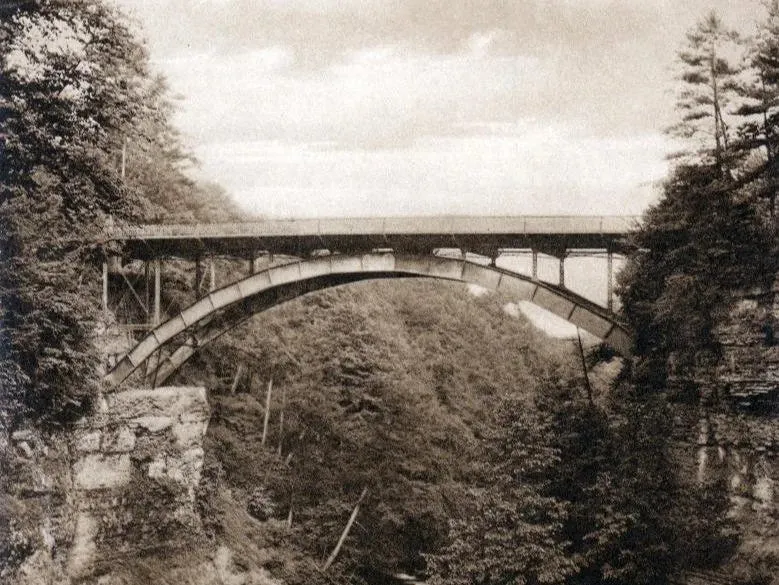
Carl’s words spilled out like shrapnel. “He jumped off the Thurston Bridge last night. “He’s in the ICU at County. Broke a bunch of bones, smashed his face, punctured a lung, but he was awake when I saw him, like an hour ago.” Carl shuddered and shook his head. “The amazing thing is he survived! I think he may be the only one, like, ever! Maybe because the water was so high. His parents are driving up now.”
Very soon the story was everywhere. A group of students had been on the bridge at 01:25 in their rain gear marveling at the torrent ripping through the gorge. They described seeing a long-haired man, alone, without a raincoat or a hat, completely drenched, who walked deliberately to the middle of the span, climbed on top of the wall, and jumped, feet-first, arms outstretched, “like Jesus.” They alerted the police immediately. The rescue crews knew approximately where to look, taking the raging current into account, and found the jumper beached much farther west than usual, on the north bank above Rocky Falls. They were astonished to find him unconscious but alive.
Elias forced himself to visit Mark in Tompkins County Hospital that evening. He was greeted warmly by Mark’s familiar but terrified parents. He saw Ginny for the first time in years. Her eyes were red-rimmed but her tears had dried and she looked fierce, more physically striking than he remembered. Ginny seemed to be the tent pole holding up the family. The right half of Mark’s face was covered in bandages. The rest of his face was a swollen mess, but his left eye sparkled acknowledgement. He moved his bruised but unbroken left arm enough to give Elias a brief hand-squeeze.
By graduation it appeared Mark would recover completely enough from his physical injuries to return to Cornell in the fall, pending clearance by his psychiatrist. After many interviews with friends and family the psychiatrist had expressed concern about the possibility of underlying schizophrenia. Elias visited Mark several more times during his long recovery. By June he seemed almost like the old Mark.
Two days before graduation from Cornell Elias heard that he had been approved for a Guaranteed Student Loan for medical school, at the maximum amount of $5,000. He wouldn’t have to worry about paying off principal until he was through with his education, which included residency. Combining the loan with support from his parents and his savings, he had reached financial wheels-up on the flight to his dream. In retrospect, Elias realized, he had overachieved in his pursuit of financial independence. But he couldn’t go back and un-sell anything. He also argued, in his defense, that leisure-product profits preserved precious time to study by freeing him from dependency on work-study income.
Elias felt like he should drop in on Mark once more, but the process of emptying his room into the family car expanded to fill all available time after graduation. On the occasions when they had met, Mark didn’t appear to have retrograde amnesia—he’d shared several details from the day he went over the railing. Elias never found the courage to ask about the acid, and Mark never brought it up. The story of the last little pink pill was left hanging between them, another tangled fiber in the warp and woof of chance and choice.

More Stone Hearts chapters:
Chapter 8: The Brothers Bessette
Next...
Related:
- A Conversation with Dr. Craig Smith on His Novel “Stone Hearts,” the Art of Writing, and the Surgeon’s Imagination
- For Us the Living: Reflections on 9/11 from Dr. Craig Smith
- Nobility in Small Things: A Look Back at The Leadership of Craig Smith, MD