

What happens when a surgeon turns his eye from the operating room to crime fiction? In "Stone Hearts", Craig R. Smith, MD, cardiac surgeon and former Chair of the Department of Surgery, builds a medical caper rooted in transplant, intrigue, and the peculiar moral weather that hovers above and beyond the hospital.
Follow along each Friday as we release the novel one chapter at a time. You can also see more on Dr. Smith's Substack, Long Incision.
In Chapter Eighteen: The Holtz Family, Eva’s family history since the 1930s was introduced, including the death of her brother, David, in a 1974 terrorist attack, two months after Eva emigrated to Israel to join her family. After graduating with distinction from Tel Aviv University, Eva joined the intelligence service of the IDF.
Cast to the Rise
In response to the 1972 Olympic massacre, the Israeli government had initiated Operation Wrath of God, under which a Mossad team, code-named Bayonet, spent years hunting down leading figures from Black September, Fatah, and the PLO. In 1979 their red laser dot shifted from first-hand perpetrators to a wealthy Armenian arms dealer named Aram Azarian, code-named the Black Prince. Azarian was a 42-year-old man born in Turkey, raised and educated in Europe and the United States, whose business was loosely headquartered in Beirut. He was the primary source of weapons and munitions for several groups that were existential enemies of Israel.
Much of Azarian’s personal fortune came from sales to violent organizations that were also active in western Europe and the Americas, which had drawn the attention of the CIA and MI5. The CIA had tried to turn him with a complicated offer they considered extremely generous, but Azarian had declined—arrogantly, in Langley’s humble opinion. CIA and MI5 were delighted to consign Azarian to anything Mossad had in mind, with their full cooperation, a tacit acknowledgement that Mossad was the most credible threat between them. Bayonet was considering options ranging from persuasion through extraordinary rendition but had not ruled out elimination.
The collective intelligence of three nations had established that the Black Prince had a weakness for young women. That provided Mossad with an opening move, a blackmail option, and the possibility of a checkmate under circumstances so embarrassing that his people would bury the story. They also knew that Rome was one of his favorite playgrounds—a short flight to a big city with lots of social life. Best of all, it was the capitol of a country increasingly sympathetic to causes he was arming, with a snoozing government for which international intrigue was for someone else to worry about after lunch.
Mossad knew Azarian would be hard to reach if he preyed only on his inner circle of black-ops groupies. To test his boundaries, Mossad had chummed the Prince twice with attractive young women, in Rome, and had established that he would rise to succulent bait from the general population—proof of concept, and noteworthy recklessness for a man in his position. In those exploratory efforts Mossad had always snatched the bait away, for the bait’s sake, as soon as the Prince turned for it. They felt ready to deploy someone who could set the hook and play the fish.
The security around the Black Prince was constant and dangerous, and the long play required bait that was not just attractive but capable of maintaining a convincing cover and an impenetrable backstory. Second Lieutenant Eva Holtz came to mind. She eagerly accepted the proposition. The team would model Eva’s opening moves on what had worked before, after which they would be reliant on her acting chops and physical confidence. Her character was Sharon Longleat, a junior at the University of Connecticut visiting Rome in an exchange program at Sapienza University. Ms. Longleat was a lissome blonde debutante from Darien, correspondingly prim and proper, but also susceptible to the charms of virile Europeans.
Informants leaked the date of the The Black Prince’s next visit to Rome, so Mossad had eyes on him from the moment he arrived. Getting Azarian’s eyes on Eva only required casting to the rise. Act One, Scene One was a sidewalk café on the Via dell ‘Orso in the late afternoon of a comfortably warm and sunny day, where the Prince was enjoying coffee drinks with two male companions. Eva entered stage left wearing a black skirt and gossamer blouse that caught many pairs of eyes. With knitted brow she studied the guidebook she was holding open in one hand. Her halting, uncertain movement between tables conveyed a sense of being lost and anxious. Eva could tell she had the Prince’s attention, but she sensed suspicion in his companions, so she flopped into a seat at a table on the periphery and declined to meet the Prince’s inviting gaze. In English she ordered an espresso, loudly enough to be overheard.
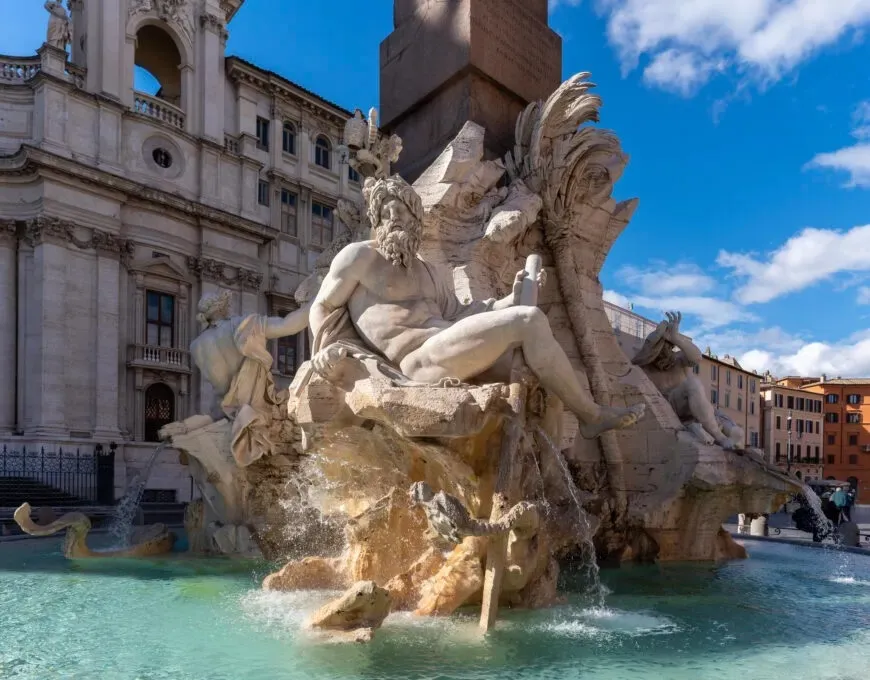
While Eva was sipping her espresso, a young man dressed like an American tourist walked by her table, noticed her guidebook, introduced himself as Peter, and asked if he could help. She invited him to sit, and they studied the guidebook together for a few minutes. He megaphoned “I know the fountains you’re looking for—with the Bernini’s. They’re over that way, on the Piazza Navona,” gesturing in that direction with one hand. “It’s not far. I’d show you, but I have to catch a train. Nice to meet you!”
Peter, whose real name was Jacob, waved and departed. Jacob was the 29-year-old son of Austrian Jews who had emigrated to Canada in 1939. He was another player in the Mossad pageant, whose role was to catalyze the action and keep Eva safe. At the Prince’s table his two companions had their backs to Eva but he was still appraising her hungrily. When they appeared to be finished with their beverages, Eva started making motions with her purse and guidebook, left coins on her check, and rose, projecting a tentative commitment to her goal. She started walking slowly in the direction Peter had indicated.
A voice at her elbow asked politely in English if she was looking for the Piazza Navona. She turned to look, and of course it was the Black Prince. His two companions flanked him just astern, alert and skeptical. Playing the inexperienced undergraduate, Eva cautiously accepted his guidance. As they walked, the Prince pointed out various features of the neighborhood, mixing in clues to his own wealth and significance, to which Eva responded with cooing admiration. By the time the Piazza was only a block away his hand had delicately migrated from her near elbow to the far side of her waist. From the edge of the Piazza she could see the three fountains spaced along its length. She turned out of his touch and thanked him for his help.
As if consciously reading lines Mossad had written for his character, Azarian asked how long she would be in Rome, where she was staying, and what she most wanted to see. He handed Eva a business card that identified him as Ramy Nero, President of Mediterranean Logistics, Beirut. Mr. Nero offered to be her guide the next afternoon and suggested a time and location. Sharon Longleat introduced herself, thanked him for his kind invitation, and said “See you tomorrow!” Nero’s two companions loitered nearby, unamused.
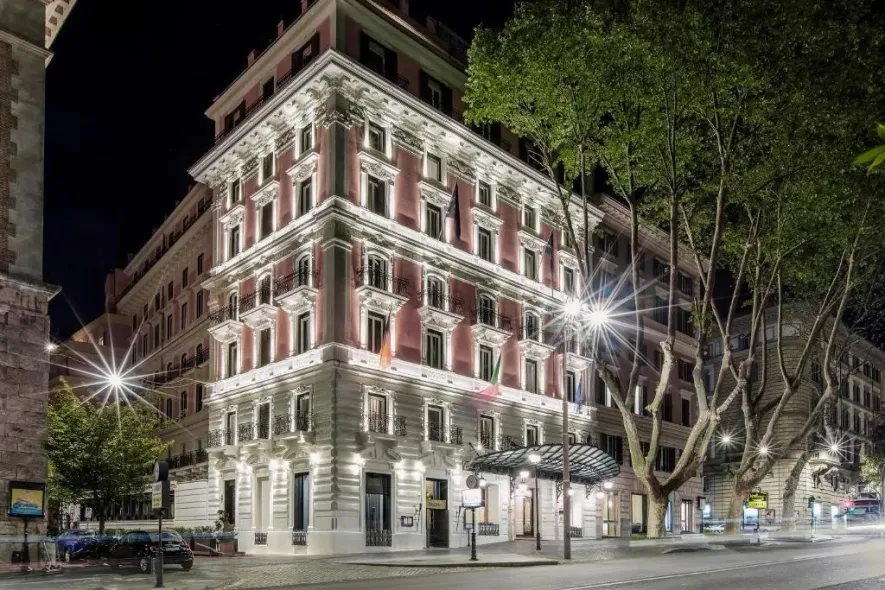
Eva and the Mossad team returned to their home base at the Hotel Canada, near Sapienza. Early that evening, a team member watching the lobby observed one of the Prince’s two companions asking for Sharon Longleat at the front desk. The next morning they saw the Prince’s other companion walking the first floor and the perimeter. Hotel staff had been primed with information supporting Eva’s story that reached the right ears. By noon the team had identified the Prince’s two companions. One was Ahmed Saleh, who had been with Black September for years but more recently had been off Mossad’s radar. He might have gone private with the Prince, or his presence might mean an important transaction was being protected by the customer. The other man was Emin Agassi, an Armenian from Ukraine, retired KGB, who had been first in command of the Prince’s personal security detail for several years.
The next day Eva met the Black Prince punctually at the designated location. Eva was dressed to display but not advertise. Azarian wore his power. He could have relied on that alone—he was an attractive man—but midlife insecurity over his early paunch, sagging chin, and receding hairline demanded an expensive Italian sport coat, a fussy dress shirt, and aggressive scents. He had only one visible wing man, who Eva now recognized as Emin Agassi. The Prince waved in Agassi’s direction and explained to Eva that his dear cousin Aziz, visiting from Tunisia, also wanted to see the sights.
Agassi hovered alertly on the periphery as they walked along. The Prince made no attempt to include him in the travelogue. He couldn’t have been a more obvious bodyguard. Was the Prince carelessly guileless, Eva wondered, or deliberately careless? Was this another way to show off his importance—the big shot who needs security? But if so, why the cousin from Tunisia story? Maybe he was suspicious, and knew that a plant would be thinking exactly what Eva was thinking, and might reveal a tell. I’m too good for that, she hoped.
Eva was not surprised when the tour objectives were extended once, and again, then a third time, while the Prince became more handsy by the hour. Eva carefully calibrated any reciprocal expressions of affection to stay barely on the encouraging side of neutrality—in a word, a tease. The endgame was still too unclear to risk premature escalation. By some amazing coincidence the last stop on the tour was only a block from the Hotel Regina, where the Prince was staying. As if slapping hand to forehead, he remembered that the Regina’s famous lobby bar was a popular celebrity watering hole, and they should drop in, if only because Ms. Longleat looked like a celebrity!
“Well, maybe one drink, but I have to meet some friends for dinner an hour from now.”
At the bar it was Scotch on the rocks for Azarian, a glass of Pinot Grigio for Eva, and an espresso for Wingman, who promptly visited the WC to do some almost performative reconnaissance. He returned to his seat looking slightly less vigilant. Eva nursed her drink and listened politely to Azarian’s sales pitch, alert for bits of potentially useful information. She excused herself to visit the WC for a brief rendezvous with Jacob, who whispered “Not here, not yet, but keep it open.”
Eva returned to the bar with a winning smile for the Prince and Wingman, thanked Mr. Nero for everything, and rushed off to join her friends for dinner. She hit her mark near the door, pivoted, and walked purposefully back to the bar. Sharon asked Mr. Nero if she could return the favor and buy him a drink some night, maybe introduce him and his friends to some of her friends? He couldn’t restrain a satisfied smile while he wrote a phone number on the back of another business card, and handed it to her. Wingman scowled and scanned the room. Ms. Longleat gave Mr. Nero a peck on the cheek and departed again.
In the debrief that followed, the team leader reminded everyone that surgical actions taken under Operation Wrath of God required case-by-case approval from the Prime Minister and the Minister of Defense. Headquarters was impressed with their progress, and the situation could change quickly, but permission had not been granted. They brainstormed possible meeting places that had advantageous sight lines, or concealment, or escape options. It the game continued, they assumed the Prince would invite Eva to his hotel room at some point. The famous Hotel Regina, built in 1892, was so well known that casing the floor plans had been easy.
Delaying Sharon’s invitation to Nero helped avoid looking overly eager and gave headquarters more time for a decision. The next evening Mr. Nero left a hand-written message at the front desk: “Looking forward to your call.” Eva called Mr. Nero’s number around noon the next day. The man who answered asked a few questions about her previous tour with Mr. Nero that she handled easily. After a short delay the Black Prince was on the line. “Sorry about all the questions,” he began, “but an international business sometimes attracts the wrong customers.” She assured him she understood, and they agreed to meet at a café near his hotel at 18:00 the following evening.
The following noon the front desk delivered another message to Eva from Mr. Nero. “Tickets to Palazzo Barberini, 16:00. Great art. See you there.” Eva’s team had finished prepping the café site and scrambled to the Palazzo. At 14:20 they reassembled to review the new plan. The team noted that the Palazzo was a huge space with innumerable rooms, nooks, and crannies, which turned anticipation into guesswork. That challenge was buffered somewhat by being a very public place, which limited the options for hunter and hunted alike. Are we sure which is which? Eva wondered. On balance, the new playing field appeared manageable at acceptable risk, a term of art that was a source of comfort when she didn’t dwell on who was at risk.
Eva trusted the others to manage the logistics. Her job was to string the Prince along with slow, simmering seduction that bound him tighter with each encounter and assured future encounters. Sex was discouraged, but keeping the Prince on the hook was more important than exactly how she did it. His roving eyes and hands hinted at what fed his libido and suggested which levers to pull. Eva had concluded that he was more of an ass-and-legs man than a big-tits man, which played to her strengths. She could work with that.
But she had seen more in the man than his erotic tells. His predatorial cunning was never entirely off-stage, but he was quite intelligent and seemed genuinely interested in art, culture, and stimulating conversation. Azarian was polite and considerate when she was his guest, even courtly. Like most well-written villains she’d encountered in fiction he was part monster, part complicated human. The human part was her way in, but it hadn’t made her any less committed to watching him die.
More Stone Hearts chapters:
Chapter 8: The Brothers Bessette
Related:
- A Conversation with Dr. Craig Smith on His Novel “Stone Hearts,” the Art of Writing, and the Surgeon’s Imagination
- For Us the Living: Reflections on 9/11 from Dr. Craig Smith
- Nobility in Small Things: A Look Back at The Leadership of Craig Smith, MD